Loading
NEW DESIGNERS ADDED WEEKLY!
The best pattern designers.
Browse & hire professional surface pattern designers for fashion, textiles, interiors & product design.
Browse & hire professional surface pattern designers for fashion, textiles, interiors & product design.
We use cookies to improve your experience and understand how PatternDesigners is used.
Discover pattern styles, motifs & structures used throughout surface pattern design, with visual examples to help you recognise every pattern type.

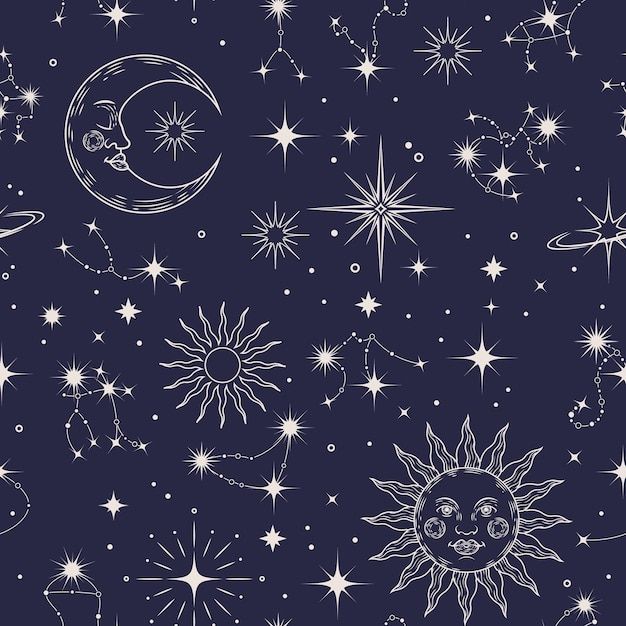
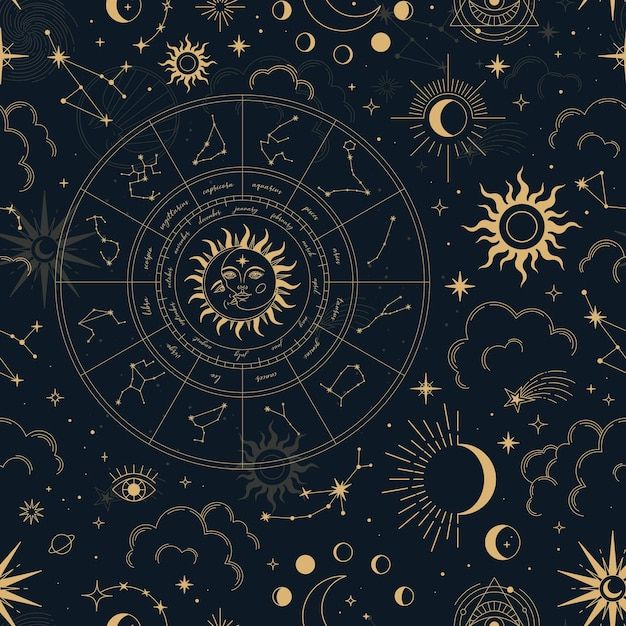
Astrology patterns are a broad celestial motif category built around the graphic vocabulary of astrology and the zodiac. Common elements include the twelve zodiac signs and their symbols, suns and moons, stars and constellations, planetary glyphs, circular horoscope charts and the lines that connect celestial points into geometric aspect patterns.This visual language has unusually deep historical roots. Astrological imagery developed alongside early attempts to observe and organise the sky, with important traditions emerging in Mesopotamia and later circulating through Egyptian, Greek, Roman, Persian, Indian, Islamic and European cultures. Across that history, astrology generated a rich visual culture found in diagrams, manuscripts, architecture and works of art. Modern astrology patterns adapt this inherited vocabulary into decorative compositions, often combining recognisable zodiac emblems with celestial and geometric motifs.
Astrology patterns are a broad celestial motif category built around the graphic vocabulary of astrology and the zodiac. Common elements include the twelve zodiac signs and their symbols, suns and moons, stars and constellations, planetary glyphs, circular horoscope charts and the lines that connect celestial points into geometric aspect patterns.
This visual language has unusually deep historical roots. Astrological imagery developed alongside early attempts to observe and organise the sky, with important traditions emerging in Mesopotamia and later circulating through Egyptian, Greek, Roman, Persian, Indian, Islamic and European cultures. Across that history, astrology generated a rich visual culture found in diagrams, manuscripts, architecture and works of art. Modern astrology patterns adapt this inherited vocabulary into decorative compositions, often combining recognisable zodiac emblems with celestial and geometric motifs.
Astrology patterns are typically symbol-rich. Zodiac glyphs, constellation figures, planets, stars, crescents and radiant suns can appear as individual motifs or as parts of larger diagrammatic compositions. Circular forms are especially prominent because the zodiac is traditionally organised as a wheel divided into signs or sections.
Astrological charts also create distinctive geometric imagery through the relationships drawn between planets. Aspect configurations can form triangles, crosses, rectangles, T-shapes, kites, hexagons and star-like structures. Named formations include the Grand Trine, Grand Cross, T-square, Yod, Kite, Grand Sextile or Star of David, Pentagram and Mystic Rectangle. These structures give astrology pattern design a natural bridge between figurative celestial imagery and abstract geometry.
The wider visual history of astrology is highly varied rather than tied to one illustration style. Surviving examples and later interpretations range from ancient and medieval diagrams and illuminated manuscripts to elaborate figurative zodiac imagery and contemporary art.
Radial structure is one of the strongest organising principles in astrology imagery. Horoscope and zodiac charts arrange information around a circular wheel, making rings, sectors, spokes and central medallions natural compositional devices. This can translate directly into mandala-like motifs or repeating circular emblems.
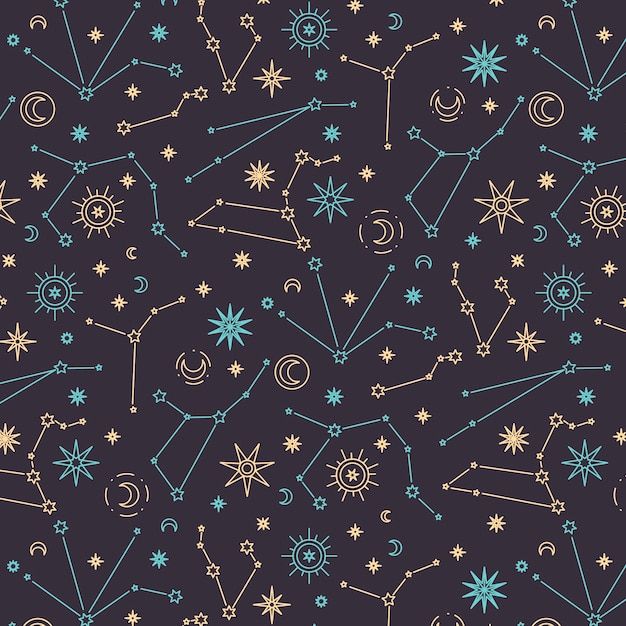
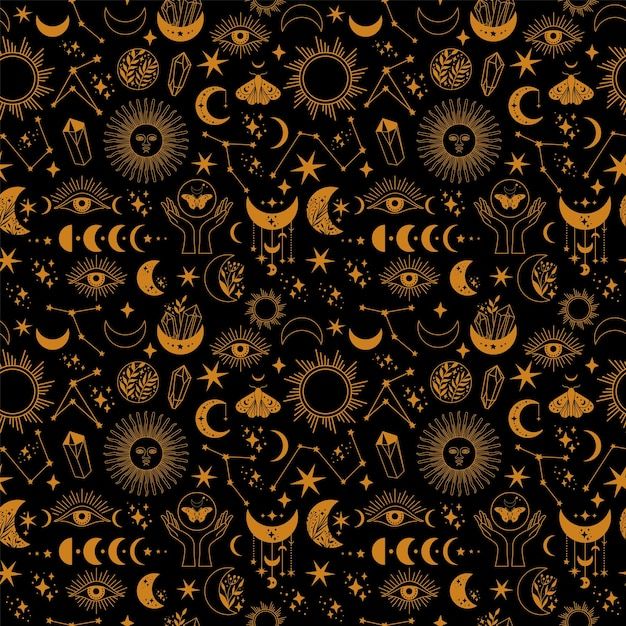
Astrology patterns can also break the wheel apart into smaller repeatable units. Individual zodiac signs, stars, moons, suns, planets and glyphs can be scattered across a surface, while constellations and aspect lines can create connected networks. Geometric aspect formations provide additional structures including triangles, squares, crosses, rectangles, hexagons and star polygons.
The twelve zodiac signs: Aries, Taurus, Gemini, Cancer, Leo, Virgo, Libra, Scorpio, Sagittarius, Capricorn, Aquarius and Pisces
Zodiac glyphs and emblematic figures associated with the signs
Horoscope and zodiac wheels
Sun, moon, planets, stars and constellations
Planetary and astrological symbols
Celestial charts, radial diagrams, rings and orbit-like lines
Aspect lines and geometric configurations such as Grand Trines, T-squares, Grand Crosses, Yods, Kites and Mystic Rectangles
Pentagrams, hexagons and other star-like geometric formations derived from chart relationships
Decorative combinations of celestial, esoteric and symbolic imagery
There is no single historical colour palette or rendering style that defines astrology pattern. Its visual history spans many cultures, periods and media, from manuscripts and diagrams to fine art and contemporary illustration.
Colour can nevertheless play a structural role in astrological charts, where contrasting colours distinguish different aspect lines or relationships. In decorative pattern work, this flexible source material allows celestial symbols and geometric forms to be treated as monochrome linework, richly illustrated emblems or multicoloured compositions without losing their recognisable astrological character.
Astrology's visual vocabulary developed over thousands of years alongside observation of the night sky. Early celestial and calendrical traditions are documented in ancient Mesopotamia, where organised systems of astrology emerged by the second millennium BC. Babylonian ideas later interacted with Egyptian and Greek traditions, contributing to the development of Hellenistic horoscopic astrology and the zodiac systems that became influential in Europe and the Mediterranean world.
Astrological knowledge continued to circulate through Persian, Indian and Islamic scholarly traditions and into medieval Europe. For centuries astrology and astronomy were closely intertwined, and zodiac signs, planetary symbols and celestial diagrams appeared across scientific, religious, literary and artistic contexts. Astrology's academic status declined as astronomy developed into a modern science, but its imagery continued in literature and art and later became familiar through popular horoscopes and contemporary visual culture.
This long history explains the stylistic breadth of astrology pattern. The same core symbols can reference ancient cosmology, medieval manuscripts, Renaissance diagrams, nineteenth- and twentieth-century esoteric imagery or modern graphic interpretations of the zodiac.
Astrology translates naturally into surface pattern because its visual system contains a large family of repeatable motifs: twelve zodiac emblems, planetary glyphs, stars, moons, suns, constellation marks and geometric chart forms. These elements can be isolated into small scattered repeats, grouped into celestial collections or organised into larger radial statement motifs.
The historical sources establish astrology as a substantial visual tradition across manuscripts, artworks and other decorated objects, while the editorial examples associated with this PatternDesigners entry show contemporary seamless treatments using constellations, zodiac wheels, suns, moons, stars and related celestial symbols. Together they make astrology especially suited to designs that combine symbolic illustration with geometric or all-over celestial patterning.
Astrology patterns are a broad celestial motif category built around the graphic vocabulary of astrology and the zodiac. This visual language has unusually deep historical roots.
Astrology patterns are typically symbol-rich. Zodiac glyphs, constellation figures, planets, stars, crescents and radiant suns can appear as individual motifs or as parts of larger diagrammatic compositions. Astrological charts also create distinctive geometric imagery through the relationships drawn between planets.
Astrology translates naturally into surface pattern because its visual system contains a large family of repeatable motifs: twelve zodiac emblems, planetary glyphs, stars, moons, suns, constellation marks and geometric chart forms.
Radial structure is one of the strongest organising principles in astrology imagery. Horoscope and zodiac charts arrange information around a circular wheel, making rings, sectors, spokes and central medallions natural compositional devices.
Celestial and Emblem
There is no single historical colour palette or rendering style that defines astrology pattern. Colour can nevertheless play a structural role in astrological charts, where contrasting colours distinguish different aspect lines or relationships.
Astrology's visual vocabulary developed over thousands of years alongside observation of the night sky. Early celestial and calendrical traditions are documented in ancient Mesopotamia, where organised systems of astrology emerged by the second millennium BC.
Star Pattern and Tessellation Pattern