Loading
NEW DESIGNERS ADDED WEEKLY!
The best pattern designers.
Browse & hire professional surface pattern designers for fashion, textiles, interiors & product design.
Browse & hire professional surface pattern designers for fashion, textiles, interiors & product design.
We use cookies to improve your experience and understand how PatternDesigners is used.
Discover pattern styles, motifs & structures used throughout surface pattern design, with visual examples to help you recognise every pattern type.

Camouflage pattern entered surface pattern design from military application. In its civilian form it functions as a graphic aesthetic rather than a functional concealment system - the pattern carries connotations of military history, outdoor/utility culture, streetwear, and counter-cultural fashion. It is commercially active across casual apparel, accessories, homeware, and stationery, and has undergone repeated fashion revivals since the 1970s. The source confirms directly: "patterns derived from military camouflage are frequently used in fashion clothing."
Camouflage pattern entered surface pattern design from military application. In its civilian form it functions as a graphic aesthetic rather than a functional concealment system - the pattern carries connotations of military history, outdoor/utility culture, streetwear, and counter-cultural fashion. It is commercially active across casual apparel, accessories, homeware, and stationery, and has undergone repeated fashion revivals since the 1970s. The source confirms directly: "patterns derived from military camouflage are frequently used in fashion clothing."
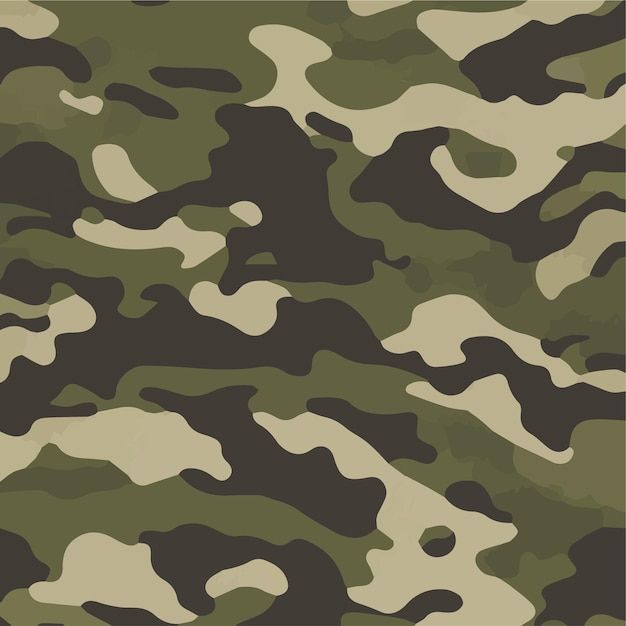
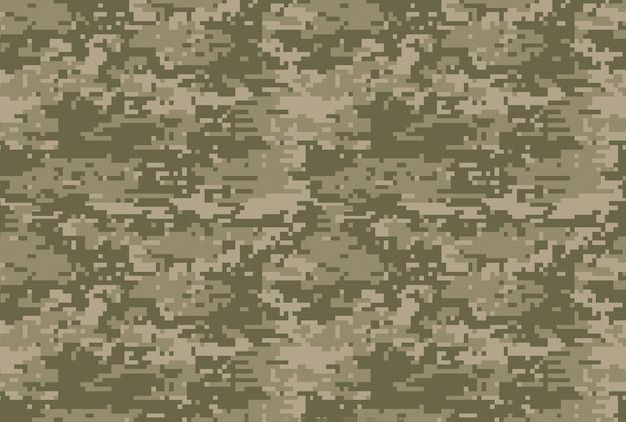
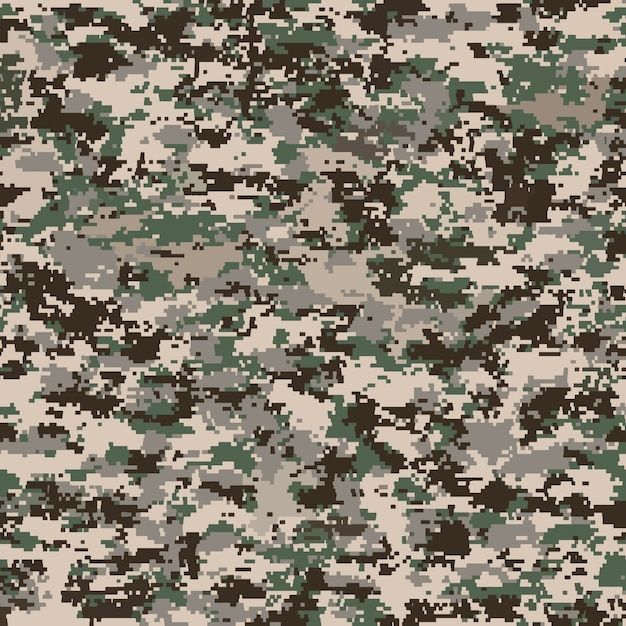
Camouflage pattern is characterised by irregular, amoebic patches of colour with soft, irregular edges - no geometric regularity. The classic military palette uses muted naturalistic tones: olive drab, khaki, earth brown, forest green, and black. Patches interlock without clean boundaries, creating a disruptive surface that obscures the shape of the wearer or object. In fashion and surface design applications, the palette is frequently updated - digital camouflage (pixelated grid), urban camouflage (grey tones), pink and pastel camouflage, and high-contrast graphic versions all exist as commercial variants.
Camouflage pattern is an all-over irregular repeat. The original military camouflage designs were engineered to avoid any detectable pattern regularity - though printed commercial versions use a tile repeat with the seams disguised within the irregular patch structure. The underlying colour-blocking logic - large amoebic zones of 3-5 colours with soft, organic edges - defines the aesthetic regardless of colourway or scale.
Camouflage pattern has no figurative motif - it is a pure colour-field pattern. Design variation is achieved through:
The classic woodland camouflage palette - olive green, mid-brown, dark brown/black, khaki tan - is the dominant commercial reference. Desert camouflage variants use sand, tan, and brown. Urban camouflage uses grey, charcoal, black, and white. Fashion camouflage recolours the base structure into any palette - brights, pastels, neons, metallics - retaining the patch structure as the recognisable formal element.
Military camouflage as a systematic practice emerged during WWI, driven by the increased accuracy of rifle fire making visible soldiers and equipment more vulnerable. Artists were recruited as camoufleurs - particularly in France, where André Mare and others applied their fine arts training to military concealment work. Dazzle ship painting - high-contrast geometric patterns designed not to conceal ships but to confuse enemy range-finders - developed simultaneously. Natural camouflage principles (background matching, disruptive coloration, countershading) inform military camouflage design. Post-WWII, military surplus camouflage clothing entered civilian use and was adopted by counter-cultural and youth fashion movements from the 1960s onwards, establishing camouflage as a permanent commercial fashion pattern.
Camouflage pattern entered surface pattern design from military application. In its civilian form it functions as a graphic aesthetic rather than a functional concealment system - the pattern carries connotations of military history, outdoor/utility culture, streetwear, and counter-cultural fashion.
Camouflage pattern is characterised by irregular, amoebic patches of colour with soft, irregular edges - no geometric regularity. The classic military palette uses muted naturalistic tones: olive drab, khaki, earth brown, forest green, and black.
Geometric
Camouflage pattern is an all-over irregular repeat. The original military camouflage designs were engineered to avoid any detectable pattern regularity - though printed commercial versions use a tile repeat with the seams disguised within the irregular patch structure.
Camouflage pattern has no figurative motif - it is a pure colour-field pattern. Design variation is achieved through: Patch scale (micro vs.
The classic woodland camouflage palette - olive green, mid-brown, dark brown/black, khaki tan - is the dominant commercial reference. Desert camouflage variants use sand, tan, and brown. Urban camouflage uses grey, charcoal, black, and white.
Military camouflage as a systematic practice emerged during WWI, driven by the increased accuracy of rifle fire making visible soldiers and equipment more vulnerable.
Leopard Pattern and Abstract Pattern