Loading
NEW DESIGNERS ADDED WEEKLY!
The best pattern designers.
Browse & hire professional surface pattern designers for fashion, textiles, interiors & product design.
Browse & hire professional surface pattern designers for fashion, textiles, interiors & product design.
We use cookies to improve your experience and understand how PatternDesigners is used.
Discover pattern styles, motifs & structures used throughout surface pattern design, with visual examples to help you recognise every pattern type.

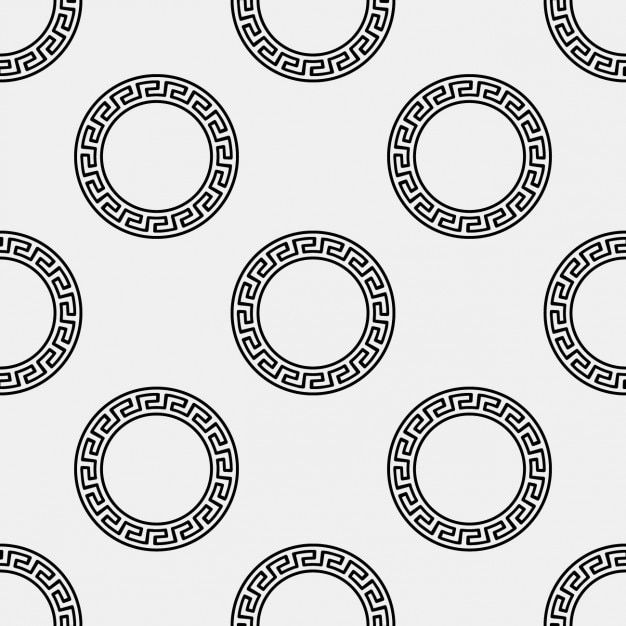
The Greek key (or meander) is a continuous geometric border motif formed by a single line turning back on itself at right angles to create a square spiral or labyrinthine sequence. It is one of the most historically persistent ornamental motifs in the world, appearing independently in ancient Chinese bronzes, Mesoamerican design, and classical Greek pottery before becoming a defining ornamental element of Neoclassical, Beaux-Arts, and Art Deco design. In surface pattern design, the Greek key is commercially active as a border, stripe, and all-over repeat in luxury interiors, fashion accessories, and licensing.
The Greek key (or meander) is a continuous geometric border motif formed by a single line turning back on itself at right angles to create a square spiral or labyrinthine sequence. It is one of the most historically persistent ornamental motifs in the world, appearing independently in ancient Chinese bronzes, Mesoamerican design, and classical Greek pottery before becoming a defining ornamental element of Neoclassical, Beaux-Arts, and Art Deco design. In surface pattern design, the Greek key is commercially active as a border, stripe, and all-over repeat in luxury interiors, fashion accessories, and licensing.
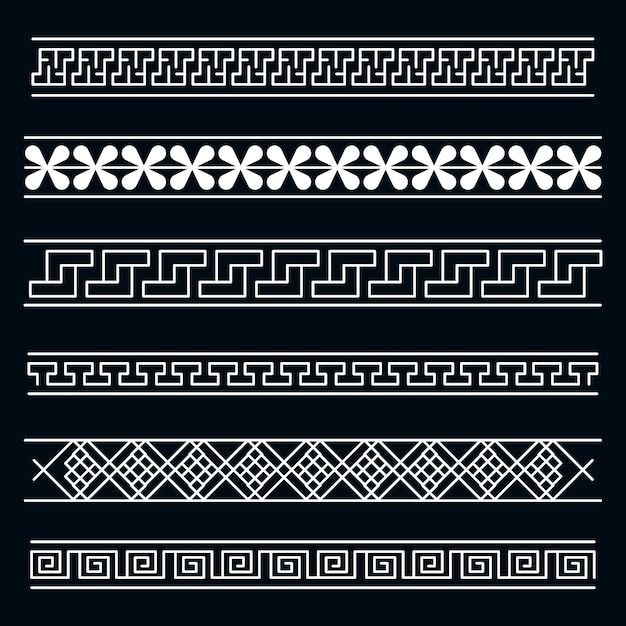
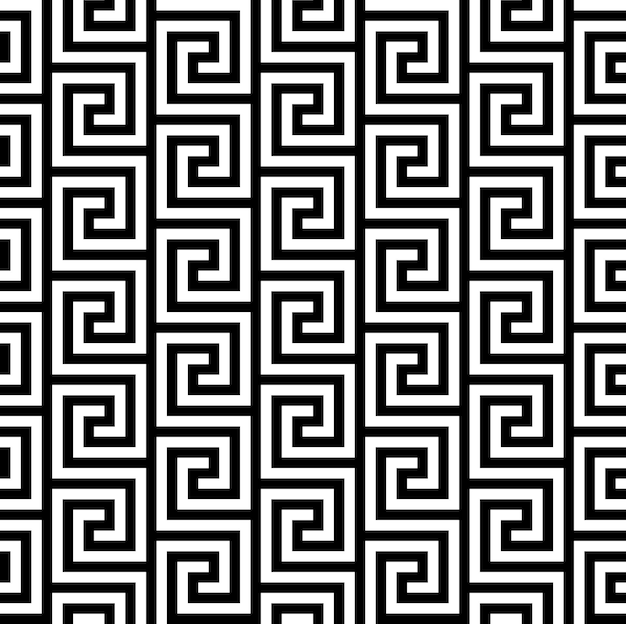
The Greek key in its standard form uses a single rectilinear line that turns at precise right angles, creating a continuous spiraling key or hook shape. The "straight" version (Greek key or Greek fret) has purely right-angle geometry. The "rounded" version - called running scrolls or wave pattern - uses curved lines to produce a flowing scroll-and-wave border. Both versions create a dense, linear border with strong visual rhythm. The pattern is typically presented as a single-colour motif on a contrasting ground - the contrast between line and ground creates the visual impact. Two-colour interlocked versions (positive and negative Greek key forms fitting together) are also used.
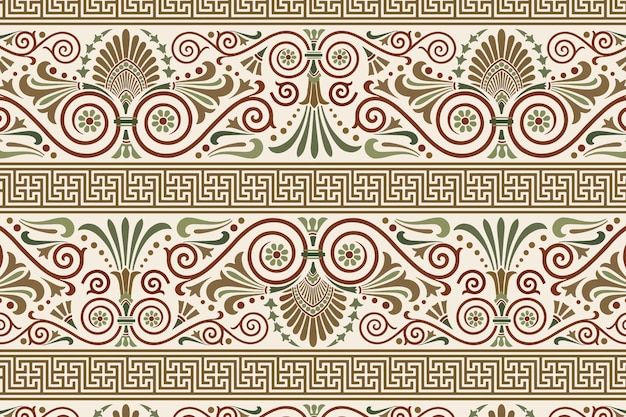
The Greek key is fundamentally a frieze or border pattern - it repeats along one axis (left to right) as a continuous strip. In this format it appears on pottery rims, architectural cornices, textile borders, and tile trim. In surface design, the Greek key is also used as:
Greek key pattern is most commercially active in two-tone applications - the classic combinations include black on cream, gold on navy, and white on terracotta. High-contrast two-colour execution is standard; the pattern loses legibility in low-contrast applications. Luxury and Neoclassical interior applications favour gold on dark (navy, black, forest green) grounds. Contemporary fashion applications use the Greek key in bold colour combinations as a border or trim element.
The squared spiral motif has independent origins in multiple ancient cultures. The Chinese Shang dynasty thunder pattern (leiwen) appears on bronze vessels dated c. 1600-1045 BC - one of the earliest documented examples of the squared spiral in decorative art. The name "meander" derives from the Maeander River (now the Büyük Menderes River in Turkey), whose characteristically winding course the Greeks used as a metaphor for the continuous turning ornament. Greek pottery from the Geometric period (c. 900-700 BC) used meander border bands extensively - the precise dating of the canonical motif to the Geometric period is documented, with specific examples from around 730-720 BC. The motif also appears in Mayan design and Byzantine mosaics, and was used in Romanesque tapestries. The Neoclassical revival of the 17th-19th centuries brought the Greek key back as a dominant ornamental motif in European decorative arts. Art Deco design, which drew heavily on Neoclassical and Egyptian sources, deployed the Greek key extensively - a dress from c. 1925 at the Musée Galliera, Paris, documents Art Deco fashion use. Scholar Karl Kerenyi described the meander as "the figure of a labyrinth in linear form."
The Greek key (or meander) is a continuous geometric border motif formed by a single line turning back on itself at right angles to create a square spiral or labyrinthine sequence.
The Greek key in its standard form uses a single rectilinear line that turns at precise right angles, creating a continuous spiraling key or hook shape. The "straight" version (Greek key or Greek fret) has purely right-angle geometry.
Heritage
The Greek key is fundamentally a frieze or border pattern - it repeats along one axis (left to right) as a continuous strip. In this format it appears on pottery rims, architectural cornices, textile borders, and tile trim.
Emblem
Greek key pattern is most commercially active in two-tone applications - the classic combinations include black on cream, gold on navy, and white on terracotta. High-contrast two-colour execution is standard; the pattern loses legibility in low-contrast applications.
The squared spiral motif has independent origins in multiple ancient cultures. The Chinese Shang dynasty thunder pattern (leiwen) appears on bronze vessels dated c. 1600-1045 BC - one of the earliest documented examples of the squared spiral in decorative art.
Frieze Pattern, Geometric Pattern, and Art Deco Pattern