Loading
NEW DESIGNERS ADDED WEEKLY!
The best pattern designers.
Browse & hire professional surface pattern designers for fashion, textiles, interiors & product design.
Browse & hire professional surface pattern designers for fashion, textiles, interiors & product design.
We use cookies to improve your experience and understand how PatternDesigners is used.
Discover pattern styles, motifs & structures used throughout surface pattern design, with visual examples to help you recognise every pattern type.

Hello Kitty pattern is a surface design category defined by the use of the Hello Kitty character and associated Sanrio imagery as primary motifs in all-over repeats and placement designs. Unlike most surface pattern types, which are defined by visual structure or motif vocabulary, Hello Kitty pattern is defined by intellectual property - the Sanrio character created in 1974 by Yuko Shimizu. Its significance in surface pattern design lies in its scale as a licensing property: it represents one of the most commercially important character licensing programmes in the world, with an estimated $8 billion in retail sales in 2013, 50,000+ licensed product lines, and operations across 130+ countries. For surface designers, Hello Kitty is a primary case study in character-based licensed pattern.
Hello Kitty pattern is a surface design category defined by the use of the Hello Kitty character and associated Sanrio imagery as primary motifs in all-over repeats and placement designs. Unlike most surface pattern types, which are defined by visual structure or motif vocabulary, Hello Kitty pattern is defined by intellectual property - the Sanrio character created in 1974 by Yuko Shimizu. Its significance in surface pattern design lies in its scale as a licensing property: it represents one of the most commercially important character licensing programmes in the world, with an estimated $8 billion in retail sales in 2013, 50,000+ licensed product lines, and operations across 130+ countries. For surface designers, Hello Kitty is a primary case study in character-based licensed pattern.
The Hello Kitty character is a simplified, anthropomorphic white cat with no mouth, a red bow (typically on the left ear), dot eyes, and a yellow nose. The design is deliberately minimal - the mouthless face is a Sanrio design philosophy decision, allowing the viewer to project their own emotions onto the character. Surface pattern using Hello Kitty typically repeats the character in various poses and expressions across the surface, often combined with other Sanrio iconography: stars, hearts, bows, flowers, and secondary characters. Colour ranges from the classic red-and-white scheme to full colour ranges specific to licensed product ranges and seasonal collections.
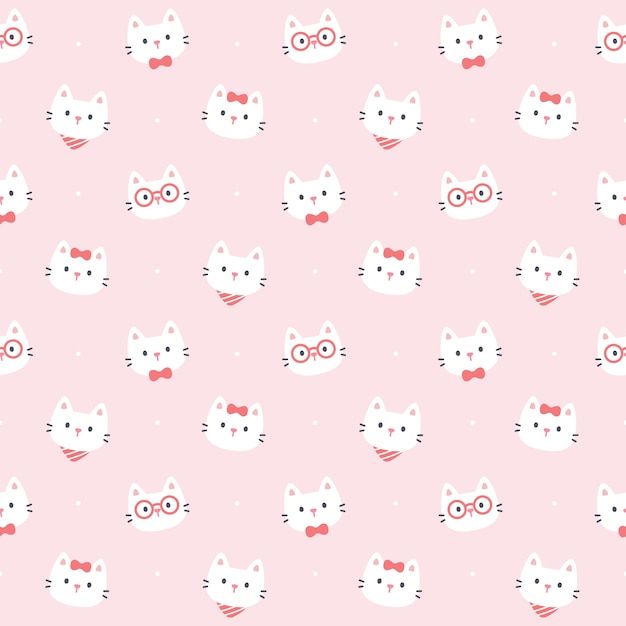
Hello Kitty surface patterns predominantly use all-over repeats of the character motif - tossed, grid, or half-drop arrangements of the face or full figure. Placement formats (large single character graphic on apparel or accessory) are also commercially active. Licensed patterns range from simplified single-colour character silhouettes to complex multi-element compositions incorporating the full Sanrio aesthetic vocabulary.
The default Hello Kitty palette is white character on coloured ground with red bow detail. Commercial licensed products use the full colour spectrum - from classic red/pink/white to all-over yellow, blue, and themed colourways tied to specific product ranges or collaborations. The aesthetic is firmly within the kawaii (Japanese cute) tradition - soft, rounded, childlike, and pastel-leaning, though adult-market extensions use more sophisticated colour treatments.
Hello Kitty was created by designer Yuko Shimizu for Sanrio in 1974. The character was first applied to a small vinyl coin purse in 1975. Yuko Yamaguchi became the lead designer in 1980 and has remained the primary creative director of the character's visual identity since. Originally positioned as a product for pre-teen girls, the character's market expanded to adults in the 1990s - particularly through fashion collaborations and the cultural export of kawaii aesthetics globally. By 2010, the character generated $5 billion per year in licensed retail sales, rising to an estimated $8 billion in 2013. 90% of Sanrio's profits derived from international licensing in 2014. Fashion collaborations include Dr. Martens (2010, 2020), Forever 21 (2011), Puma (2018), Converse (2018, 2026), and Skechers (2020). Brand recognition among US 18-23 year-olds reached over 80% by 2016. A live-action/animation film is scheduled for summer 2028 (New Line/Warner Bros. Pictures Animation).
Hello Kitty pattern is a surface design category defined by the use of the Hello Kitty character and associated Sanrio imagery as primary motifs in all-over repeats and placement designs.
The Hello Kitty character is a simplified, anthropomorphic white cat with no mouth, a red bow (typically on the left ear), dot eyes, and a yellow nose. The design is deliberately minimal - the mouthless face is a Sanrio design philosophy decision, allowing the viewer to project their own emotions onto the character.
Novelty
Hello Kitty surface patterns predominantly use all-over repeats of the character motif - tossed, grid, or half-drop arrangements of the face or full figure. Placement formats (large single character graphic on apparel or accessory) are also commercially active.
)
The default Hello Kitty palette is white character on coloured ground with red bow detail. Commercial licensed products use the full colour spectrum - from classic red/pink/white to all-over yellow, blue, and themed colourways tied to specific product ranges or collaborations.
Hello Kitty was created by designer Yuko Shimizu for Sanrio in 1974. The character was first applied to a small vinyl coin purse in 1975. Yuko Yamaguchi became the lead designer in 1980 and has remained the primary creative director of the character's visual identity since.