Loading
NEW DESIGNERS ADDED WEEKLY!
The best pattern designers.
Browse & hire professional surface pattern designers for fashion, textiles, interiors & product design.
Browse & hire professional surface pattern designers for fashion, textiles, interiors & product design.
We use cookies to improve your experience and understand how PatternDesigners is used.
Discover pattern styles, motifs & structures used throughout surface pattern design, with visual examples to help you recognise every pattern type.

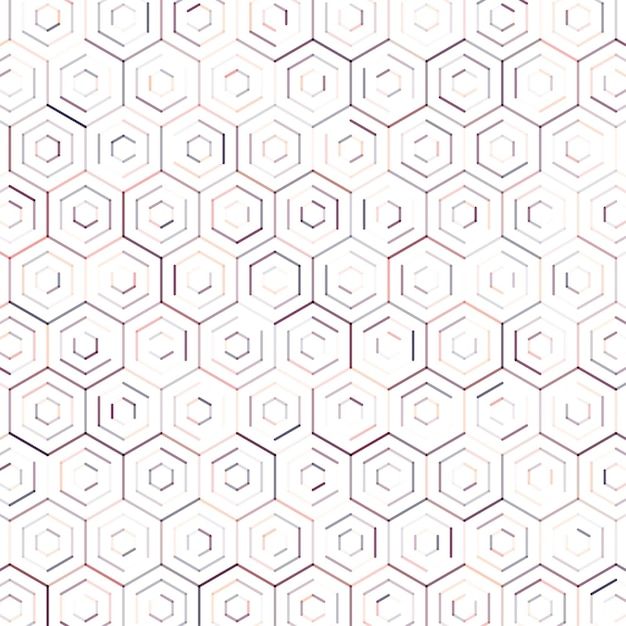
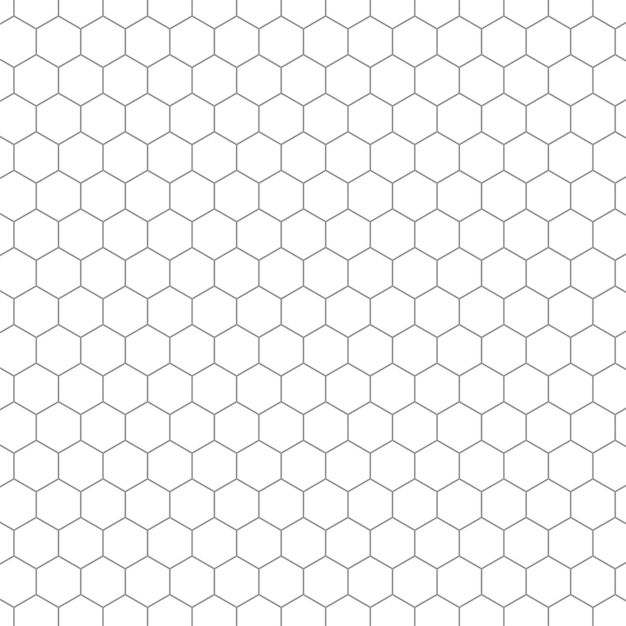
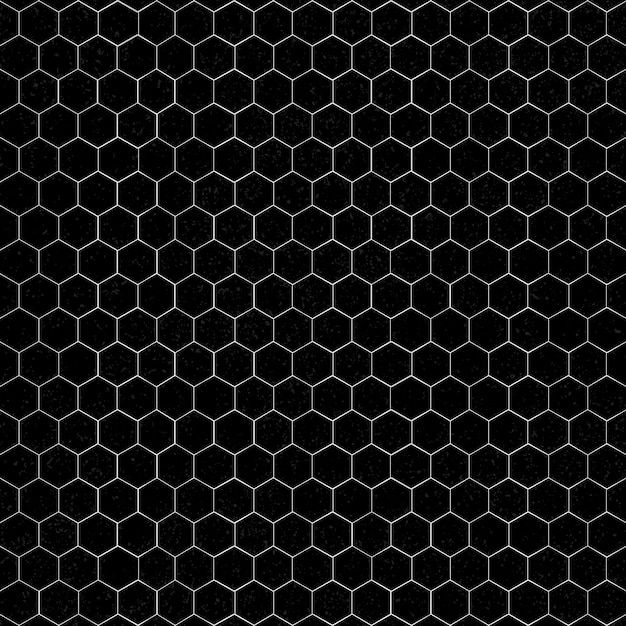
The hexagon pattern is built from regular hexagons - six-sided polygons with equal sides and 120-degree internal angles. Three hexagons meet at each vertex, which accounts for the full 360 degrees and produces a mathematically stable, gapless tessellation. In surface pattern design, this structure appears in two primary forms: the pure geometric grid, and the nature-referencing honeycomb, where the hexagonal cells evoke beeswax construction. The hexagonal tessellation has mathematical properties that make it widely useful: it covers a plane surface with the least total perimeter for a given area (the honeycomb theorem), and circles inscribed within hexagonal cells achieve the densest possible two-dimensional packing. These structural efficiencies have contributed to the form's persistence across many decorative and applied design traditions.
The hexagon pattern is built from regular hexagons - six-sided polygons with equal sides and 120-degree internal angles. Three hexagons meet at each vertex, which accounts for the full 360 degrees and produces a mathematically stable, gapless tessellation. In surface pattern design, this structure appears in two primary forms: the pure geometric grid, and the nature-referencing honeycomb, where the hexagonal cells evoke beeswax construction.
The hexagonal tessellation has mathematical properties that make it widely useful: it covers a plane surface with the least total perimeter for a given area (the honeycomb theorem), and circles inscribed within hexagonal cells achieve the densest possible two-dimensional packing. These structural efficiencies have contributed to the form's persistence across many decorative and applied design traditions.
Hexagon patterns read as structured and orderly but with more visual dynamism than square grids. The 120-degree angles create a more organic feel than orthogonal geometry while remaining fully geometric. The pattern's directionality is ambiguous - it can be read as vertical columns, diagonal rows, or horizontal bands depending on orientation, which gives designers compositional flexibility.
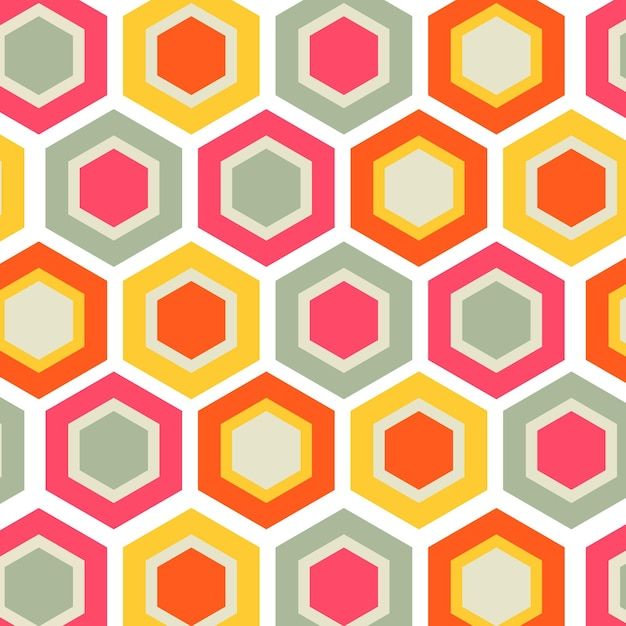
At fine scale, hexagonal grids read as textural. At larger scale, individual hexagons become distinct decorative units suitable for colour blocking, filling with secondary patterns, or stacking with varied fills.
The hexagon tile in a regular tessellation (symmetry group p6m) is vertex-transitive, edge-transitive, and face-transitive - meaning any vertex, edge, or tile can be mapped to any other by the symmetry operations of the group. This gives it one of the highest possible degrees of regularity among plane tilings.
Dual to the hexagonal tiling is the triangular tiling - connecting the centres of adjacent hexagons produces equilateral triangles. This relationship is often exploited in surface pattern design to create nested geometric compositions.
Common structural variants include:
Natural associations with amber, gold, and honey tones dominate the honeycomb variant. Geometric applications use the full colour spectrum, with high-contrast black-and-white, pastels for homeware, and bold primaries for children's products among the commercially common ranges.
The hexagon's dual identity - mathematical precision combined with its natural origin in bee construction - gives it broad positioning. It works in masculine-coded geometric design (black/charcoal/gold), in Scandi-minimalist interiors (muted mid-tones on white), and in maximalist wallpaper with rich fills.
The hexagonal tiling has been used in decorative arts across many cultures and periods. Its presence in Islamic geometric art, Moroccan zellige tilework, and Roman mosaic floors predates modern surface pattern design by centuries. In quilting, English paper piecing using hexagonal papers (the "grandmother's flower garden" quilt) is a well-established tradition. The form's mathematical elegance was documented by Lord Kelvin and later definitively proven by Thomas Hales (the Honeycomb Conjecture, 2001).
The hexagon pattern is built from regular hexagons - six-sided polygons with equal sides and 120-degree internal angles. Three hexagons meet at each vertex, which accounts for the full 360 degrees and produces a mathematically stable, gapless tessellation.
Hexagon patterns read as structured and orderly but with more visual dynamism than square grids. The 120-degree angles create a more organic feel than orthogonal geometry while remaining fully geometric.
Geometric
The hexagon tile in a regular tessellation (symmetry group p6m) is vertex-transitive, edge-transitive, and face-transitive - meaning any vertex, edge, or tile can be mapped to any other by the symmetry operations of the group. This gives it one of the highest possible degrees of regularity among plane tilings.
Geometric
Natural associations with amber, gold, and honey tones dominate the honeycomb variant. Geometric applications use the full colour spectrum, with high-contrast black-and-white, pastels for homeware, and bold primaries for children's products among the commercially common ranges.
The hexagonal tiling has been used in decorative arts across many cultures and periods. Its presence in Islamic geometric art, Moroccan zellige tilework, and Roman mosaic floors predates modern surface pattern design by centuries.