Loading
NEW DESIGNERS ADDED WEEKLY!
The best pattern designers.
Browse & hire professional surface pattern designers for fashion, textiles, interiors & product design.
Browse & hire professional surface pattern designers for fashion, textiles, interiors & product design.
We use cookies to improve your experience and understand how PatternDesigners is used.
Discover pattern styles, motifs & structures used throughout surface pattern design, with visual examples to help you recognise every pattern type.

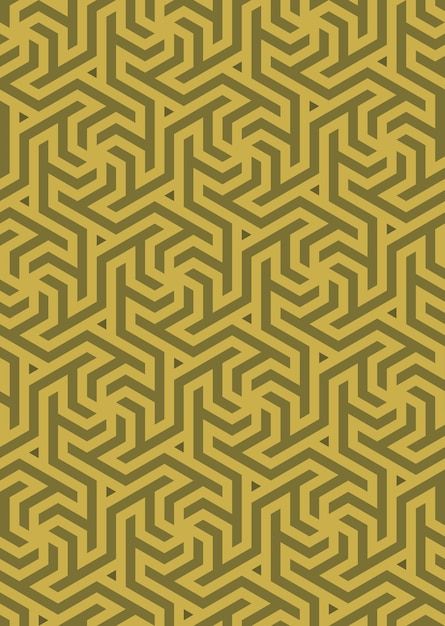
Interlocking patterns are built on the principle that changing or removing one element disrupts the whole composition. Individual units - circles, squares, organic shapes, or custom forms - combine with their neighbour's negative space to produce a continuous, gap-free surface. The pattern depends on the designed relationship between every element rather than on any single isolated motif. This compositional principle is closely related to tessellation but extends beyond strict geometric tiling to include organic or custom-shaped elements that interlock through deliberate design. The result is a surface with no visible background: the entire field is occupied by the interlocking units.
Interlocking patterns are built on the principle that changing or removing one element disrupts the whole composition. Individual units - circles, squares, organic shapes, or custom forms - combine with their neighbour's negative space to produce a continuous, gap-free surface. The pattern depends on the designed relationship between every element rather than on any single isolated motif.
This compositional principle is closely related to tessellation but extends beyond strict geometric tiling to include organic or custom-shaped elements that interlock through deliberate design. The result is a surface with no visible background: the entire field is occupied by the interlocking units.
Interlocking patterns share several defining visual qualities:
At scale, interlocking patterns can produce secondary shapes - stars, flowers, or other forms - that emerge from the negative spaces between primary units, creating two levels of pattern reading simultaneously.
The interlocking principle operates on a modular grid - typically derived from a circle grid, square grid, or hexagonal grid - which is then modified to create the interlock. The basic process:
Islamic geometric pattern, M.C. Escher's tessellating animals, and Celtic interlace all use variants of this approach at different levels of complexity. Contemporary surface pattern design most commonly applies it in geometric abstraction and in graphic tile-effect prints.
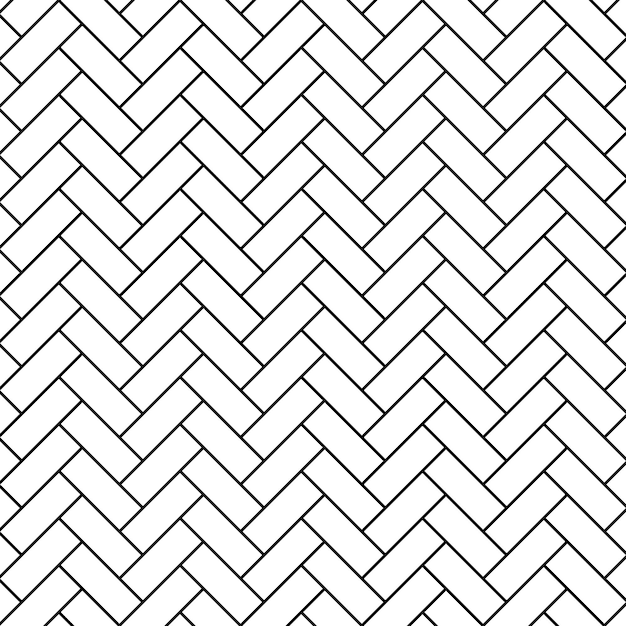
Two-tone compositions (black and white, or two contrasting colours) are most effective for emphasising the interlocking relationship and the figure-ground dynamic. Monochrome versions make the structural logic immediately readable.
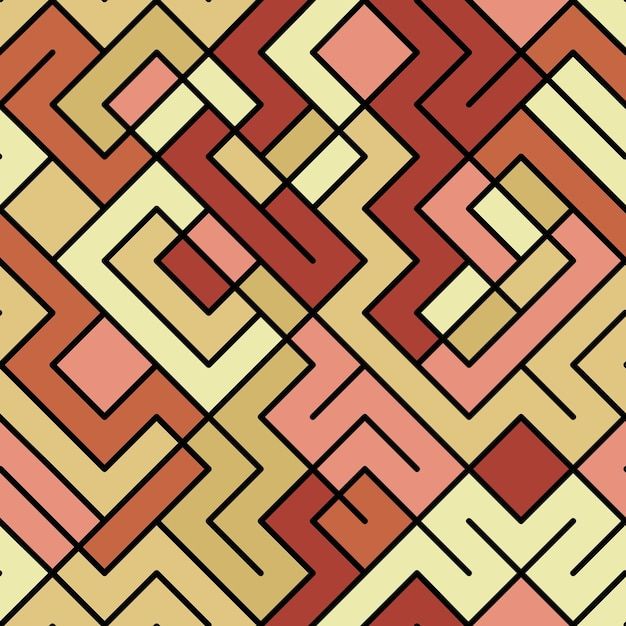
Multi-colour versions assign different fills to alternating units, often revealing secondary geometric shapes through colour sequencing. Gradient fills within interlocking forms can create three-dimensional or sculptural effects.
Interlocking pattern has deep roots in Islamic geometric art, where circle and polygon constructions were used to generate complex interlocking star patterns for architectural decoration, tile, and textile. The tradition was brought into Western design consciousness through Orientalist influence in the 19th century and through the work of M.C. Escher, whose tessellating figures became widely known.
In textile design, interlock knit (a double-knit fabric construction) uses interlocking loop structure to create a thick, stable fabric - a parallel application of the interlocking principle in construction rather than surface design.
Writer Eva Schicker (2021) described interlocking design as an emerging visual vocabulary moving through typography, iconography, logo design, and structural composition, noting that "seemingly organic shapes emerge by fusing with the negative spaces in between the base elements."
Interlocking patterns are built on the principle that changing or removing one element disrupts the whole composition. Individual units - circles, squares, organic shapes, or custom forms - combine with their neighbour's negative space to produce a continuous, gap-free surface.
Geometric
The interlocking principle operates on a modular grid - typically derived from a circle grid, square grid, or hexagonal grid - which is then modified to create the interlock. C. Escher's tessellating animals, and Celtic interlace all use variants of this approach at different levels of complexity.
Geometric
Two-tone compositions (black and white, or two contrasting colours) are most effective for emphasising the interlocking relationship and the figure-ground dynamic. Monochrome versions make the structural logic immediately readable.
Interlocking pattern has deep roots in Islamic geometric art, where circle and polygon constructions were used to generate complex interlocking star patterns for architectural decoration, tile, and textile. C. Escher, whose tessellating figures became widely known.