Loading
NEW DESIGNERS ADDED WEEKLY!
The best pattern designers.
Browse & hire professional surface pattern designers for fashion, textiles, interiors & product design.
Browse & hire professional surface pattern designers for fashion, textiles, interiors & product design.
We use cookies to improve your experience and understand how PatternDesigners is used.
Discover pattern styles, motifs & structures used throughout surface pattern design, with visual examples to help you recognise every pattern type.

Stippling is the use of small marks - typically dots or short flicks - to simulate graduated shading or to create an overall textural surface. In surface pattern design, stipple can be used as both a mark-making technique (producing visible dot texture within motifs) and as an all-over pattern in its own right, where densely or variably distributed dots form the design surface. The aesthetic is strongly associated with fine illustration, engraving traditions, and scientific botanical drawing, and carries associations of precision, craft, and vintage printmaking.
Stippling is the use of small marks - typically dots or short flicks - to simulate graduated shading or to create an overall textural surface. In surface pattern design, stipple can be used as both a mark-making technique (producing visible dot texture within motifs) and as an all-over pattern in its own right, where densely or variably distributed dots form the design surface. The aesthetic is strongly associated with fine illustration, engraving traditions, and scientific botanical drawing, and carries associations of precision, craft, and vintage printmaking.
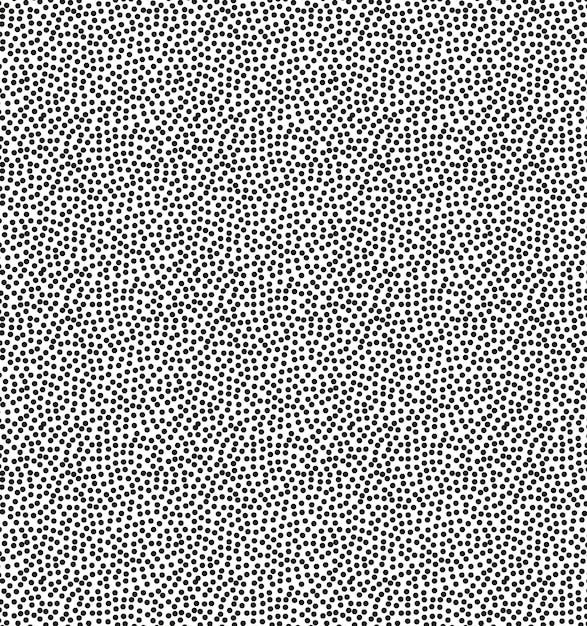
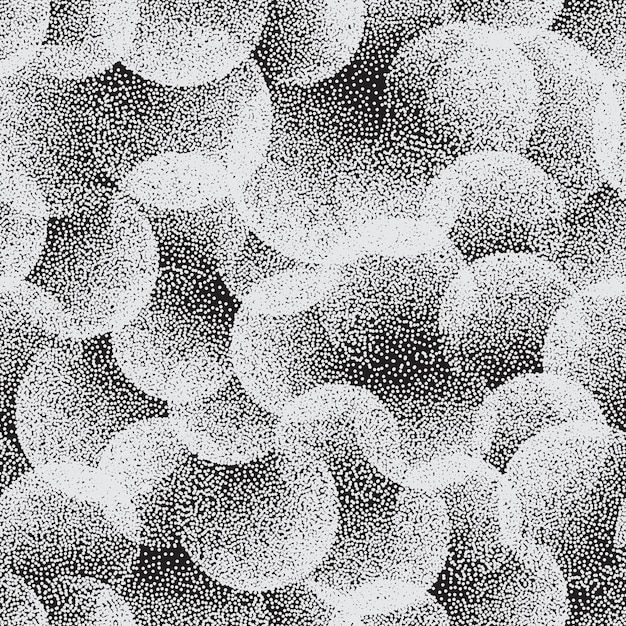
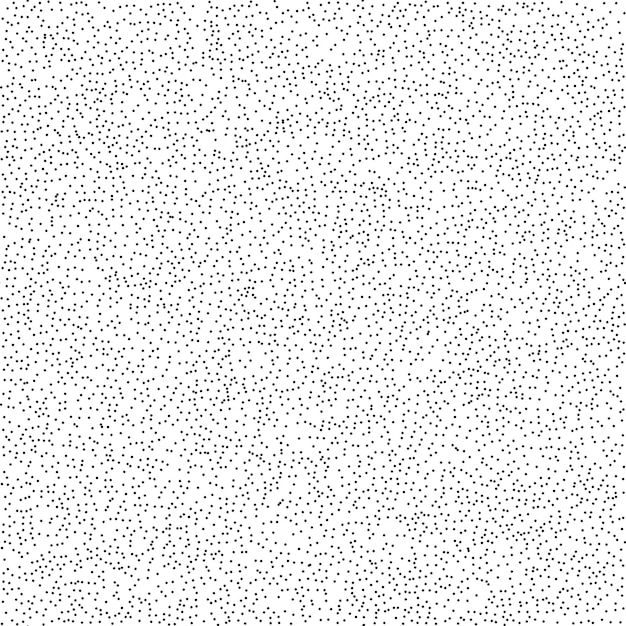
A stipple pattern reads as a field of dots, varying in density and size to create tonal depth: denser dots produce darker areas, sparse dots produce lighter areas. At close range the individual marks are visible; at distance the eye reads them as continuous tone or texture. The dots themselves may be perfectly circular, hand-drawn and slightly irregular, or short curved strokes (as in traditional engraving stipple). Digital stipple patterns may be entirely regular (a true dot field) or simulate hand-drawn irregularity.
The quality differs from pointillism, which uses dots of contrasting colours to simulate mixed colour through optical blending. Stipple conventionally uses dots of a single colour (often monochrome) to create light/dark variation rather than hue variation.
As a surface pattern, stipple is typically used as an all-over or background texture - a field of dots at consistent or varied density covering the full surface. It may be combined with other motifs as a texture element rather than used as the primary design. When used as the sole design element, the pattern's visual interest comes from density gradients, dot size variation, or the spatial rhythm of the dot field itself.
Stipple technique is applied to existing motifs (florals, animals, landscapes rendered in a stipple illustration style) or used as pure texture. As a stand-alone pattern, the motif is the dot field itself.
Typically monochrome - black dots on white ground, or white dots on dark ground. The technique translates into two-colour print contexts naturally. Multi-colour stipple (different colours of dots distributed across the surface) is less common but used in some decorative contexts. The overall aesthetic is associated with illustration, vintage botanical drawing, and fine-line printmaking traditions.
Stippling as an art technique has a documented history in printmaking from at least the early 16th century. Giulio Campagnola's engraving The Young Shepherd (c.1510) is an early example of stipple engraving technique using flicks of the burin to build tonal gradations. The technique was also applied to engraved glass, to porcelain decoration (documented on Capodimonte porcelain, mid-18th century), and to printmaking reproductions.
In botanical drawing and scientific illustration, stippling became a standard technique for rendering three-dimensional form - the denser the dots, the darker the shadow - producing the characteristic appearance of 18th and 19th-century natural history illustration. The technique occurs naturally in some plant species: stippling in botany refers to dot-like patterns occurring on flower petals and sepals, as seen for example on Calochortus luteus (California gold fields lily).
In contemporary surface pattern design, stipple aesthetic has been revived through the popularity of fine-line illustration styles and vintage-inspired print design.
Stippling is the use of small marks - typically dots or short flicks - to simulate graduated shading or to create an overall textural surface.
A stipple pattern reads as a field of dots, varying in density and size to create tonal depth: denser dots produce darker areas, sparse dots produce lighter areas. At close range the individual marks are visible; at distance the eye reads them as continuous tone or texture.
Fundamentals
As a surface pattern, stipple is typically used as an all-over or background texture - a field of dots at consistent or varied density covering the full surface. It may be combined with other motifs as a texture element rather than used as the primary design.
Stipple technique is applied to existing motifs (florals, animals, landscapes rendered in a stipple illustration style) or used as pure texture. As a stand-alone pattern, the motif is the dot field itself.
Typically monochrome - black dots on white ground, or white dots on dark ground. The technique translates into two-colour print contexts naturally. Multi-colour stipple (different colours of dots distributed across the surface) is less common but used in some decorative contexts.
Stippling as an art technique has a documented history in printmaking from at least the early 16th century. 1510) is an early example of stipple engraving technique using flicks of the burin to build tonal gradations.
Polka dot Pattern, Texture Pattern, and Botanical Pattern