Loading
NEW DESIGNERS ADDED WEEKLY!
The best pattern designers.
Browse & hire professional surface pattern designers for fashion, textiles, interiors & product design.
Browse & hire professional surface pattern designers for fashion, textiles, interiors & product design.
We use cookies to improve your experience and understand how PatternDesigners is used.
Discover pattern styles, motifs & structures used throughout surface pattern design, with visual examples to help you recognise every pattern type.

Art Nouveau was a complete design movement spanning architecture, furniture, glass, ceramics, jewellery, textiles, and graphic arts. In surface pattern design, it is a foundational historical style with persistent commercial relevance - particularly in premium textiles, wallpaper, and licensing. Its botanical vocabulary, linear elegance, and association with the Belle Époque carry strong heritage value across luxury, interiors, and editorial markets. The style experienced significant revival in the 1960s and has remained commercially active since.
Art Nouveau was a complete design movement spanning architecture, furniture, glass, ceramics, jewellery, textiles, and graphic arts. In surface pattern design, it is a foundational historical style with persistent commercial relevance - particularly in premium textiles, wallpaper, and licensing. Its botanical vocabulary, linear elegance, and association with the Belle Époque carry strong heritage value across luxury, interiors, and editorial markets. The style experienced significant revival in the 1960s and has remained commercially active since.
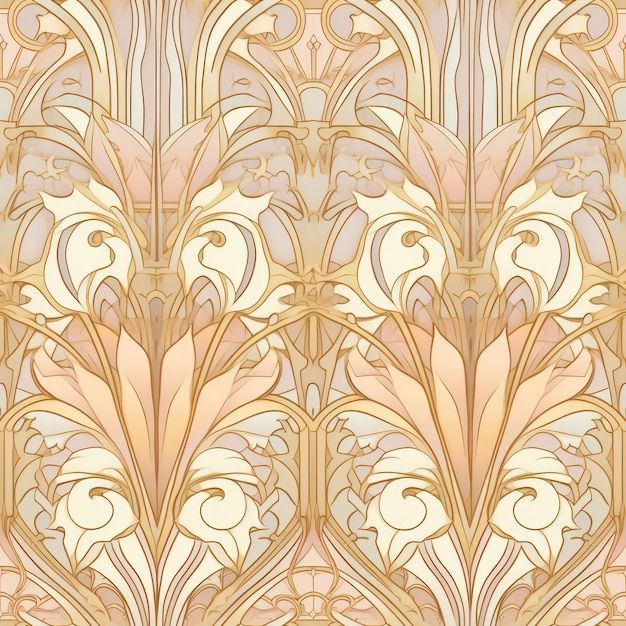
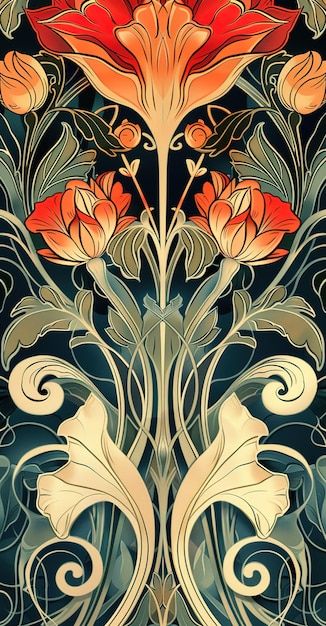
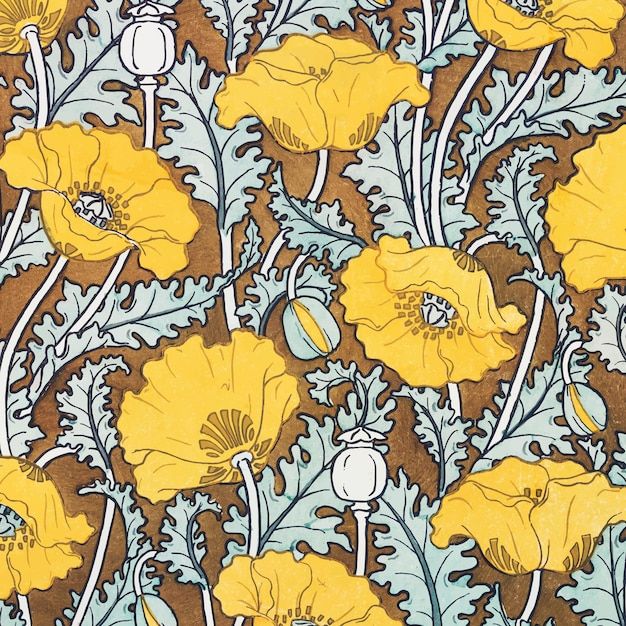
Art Nouveau pattern is defined by flowing, sinuous curves - the "whiplash" line is the signature form. Compositions are asymmetric, emphasising dynamism and movement rather than static symmetry. Plant stems, lily pads, irises, vines, and flowing hair are recurring visual vocabulary. Figurative elements - particularly elongated, graceful female figures - are integrated into organic botanical compositions. The emphasis is on line as the expressive element, with form following the contour of natural growth. Surface decoration is rich but not heavy; patterns carry a sense of breath and space despite their complexity.
Art Nouveau pattern commonly uses flowing all-over repeat structures in which stems and tendrils create organic connections across the repeat unit. Medallion and panel compositions are used in architectural and wallpaper applications. Borders and framing elements make heavy use of curvilinear vine and stem forms. Bilateral symmetry appears but is frequently softened by organic asymmetry - unlike the rigid mirror symmetry of Art Deco.
Art Nouveau uses naturalistic muted tones drawn from botanical observation: olive green, sage, mustard, ochre, deep teal, dusty rose, and off-white. Stained glass and enamel traditions (Tiffany, Lalique) introduced jewel-tone saturated colours - amber, cobalt, deep purple, and emerald. Alphonse Mucha's lithographic poster work used soft peachy flesh tones, sage green, and gold. The palette is characteristically softer and more naturalistic than Art Deco, with frequent use of muted secondary hues rather than primary contrasts.
Art Nouveau emerged in Brussels and Paris in the 1880s-1890s as a deliberate movement to reform decorative arts by rejecting historical pastiche and replacing it with a new visual language rooted in living nature. Two key influences shaped the movement: the Arts and Crafts movement of William Morris, which had championed handcraft, botanical ornament, and total design integration; and Japonism - the European absorption of Japanese woodblock print aesthetics (asymmetry, flat colour, nature-derived line, and compositional cropping). Victor Horta's Hôtel Tassel in Brussels (1893) is considered the first fully realised Art Nouveau building. Hector Guimard designed the Paris Métro station entrances in cast iron Art Nouveau. Alphonse Mucha's lithographic posters established the graphic vocabulary of Art Nouveau internationally. René Lalique worked in glass and jewellery. Louis Comfort Tiffany developed the stained glass application in the United States. The style carried different national names: Jugendstil (Germany and Austria), Stile Liberty (Italy, after Liberty of London's fabric store), Modernisme (Catalonia), and Modern Style (Britain). Art Nouveau faded from fashion by around 1910, overtaken by geometric rationalism and the emergence of Art Deco. A major revival in the 1960s reintroduced Art Nouveau imagery into graphic design and poster art, and its commercial presence has been sustained since.
Art Nouveau was a complete design movement spanning architecture, furniture, glass, ceramics, jewellery, textiles, and graphic arts. In surface pattern design, it is a foundational historical style with persistent commercial relevance - particularly in premium textiles, wallpaper, and licensing.
Art Nouveau pattern is defined by flowing, sinuous curves - the "whiplash" line is the signature form. Compositions are asymmetric, emphasising dynamism and movement rather than static symmetry. Plant stems, lily pads, irises, vines, and flowing hair are recurring visual vocabulary.
Heritage
Art Nouveau pattern commonly uses flowing all-over repeat structures in which stems and tendrils create organic connections across the repeat unit. Medallion and panel compositions are used in architectural and wallpaper applications. Borders and framing elements make heavy use of curvilinear vine and stem forms.
Botanical
Art Nouveau uses naturalistic muted tones drawn from botanical observation: olive green, sage, mustard, ochre, deep teal, dusty rose, and off-white. Stained glass and enamel traditions (Tiffany, Lalique) introduced jewel-tone saturated colours - amber, cobalt, deep purple, and emerald.
Art Nouveau emerged in Brussels and Paris in the 1880s-1890s as a deliberate movement to reform decorative arts by rejecting historical pastiche and replacing it with a new visual language rooted in living nature.
Art Deco Pattern, Botanical Pattern, Arabesque Pattern, and Floral Pattern