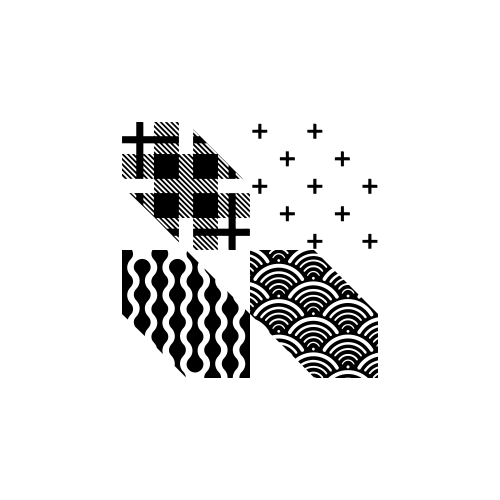
The ogee is defined geometrically as a double curve in which a concave arc flows smoothly into a convex arc (or vice versa), forming an elongated S-shape. In surface pattern design, the ogee motif is deployed as a repeating unit that interlocks with its neighbours to cover a plane seamlessly - producing the characteristic field of pointed oval or onion-dome shapes. The ogee pattern appears in textiles as early as the 12th century and has been a continuous feature of decorative arts through the Gothic and Renaissance periods to the present day. It is commercially associated with wallpaper, damask fabric, furnishing textiles, and high-end interior design. The shape's elegant proportions and historical pedigree give it a luxury and heritage positioning across markets.
Simple Repeating Pattern
0
A simple repeating pattern is a design in which one or more motifs are systematically duplicated to create an infinitely continuous surface. The repeat unit - the smallest tile that contains the complete design - is placed according to a layout rule that governs how tiles relate to each other spatially. Understanding these layout rules is considered one of the core technical competencies of surface pattern design. Once motifs are established, a designer can produce multiple coordinating patterns by applying different repeat layouts to the same elements.
Types of Repeat Pattern
0
A repeat pattern is any surface design in which a tile (or repeat unit) tessellates seamlessly across a surface. The type of repeat defines the geometric rule by which tiles relate to each other. Different repeat structures produce distinct visual rhythms and suit different markets and applications. In a pattern collection, multiple repeat types are typically used across the hero pattern and its coordinating designs to create variety and hierarchy within a unified colour and motif vocabulary.