Loading
NEW DESIGNERS ADDED WEEKLY!
The best pattern designers.
Browse & hire professional surface pattern designers for fashion, textiles, interiors & product design.
Browse & hire professional surface pattern designers for fashion, textiles, interiors & product design.
We use cookies to improve your experience and understand how PatternDesigners is used.
Discover pattern styles, motifs & structures used throughout surface pattern design, with visual examples to help you recognise every pattern type.

The unicorn pattern draws on the mythological single-horned horse as a decorative motif, almost exclusively in its contemporary commercial form: a brightly coloured, pastel, or rainbow-palette character with a spiralling horn, flowing mane, and often surrounded by stars, clouds, rainbows, and sparkle elements. The motif reached peak commercial prominence around 2017, driven by social-media-amplified consumer aesthetics across food, beauty, fashion, and homeware. As a surface pattern type, unicorn prints remain commercially active in children's products, gifting, and seasonal novelty lines.
The unicorn pattern draws on the mythological single-horned horse as a decorative motif, almost exclusively in its contemporary commercial form: a brightly coloured, pastel, or rainbow-palette character with a spiralling horn, flowing mane, and often surrounded by stars, clouds, rainbows, and sparkle elements. The motif reached peak commercial prominence around 2017, driven by social-media-amplified consumer aesthetics across food, beauty, fashion, and homeware. As a surface pattern type, unicorn prints remain commercially active in children's products, gifting, and seasonal novelty lines.
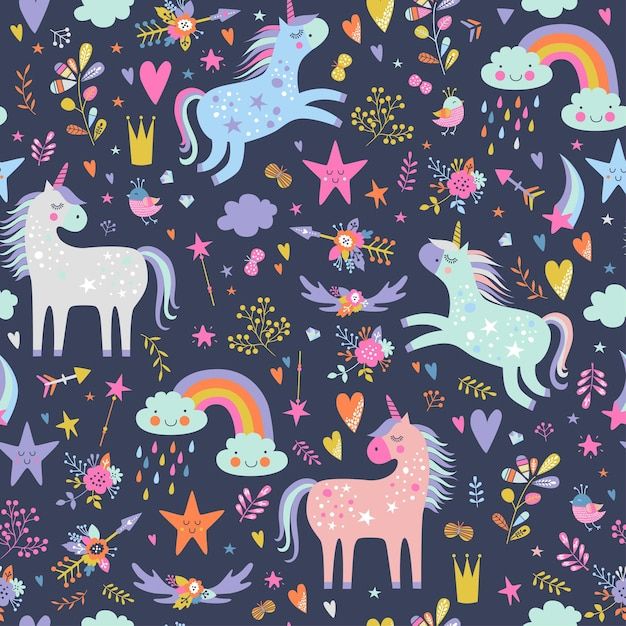
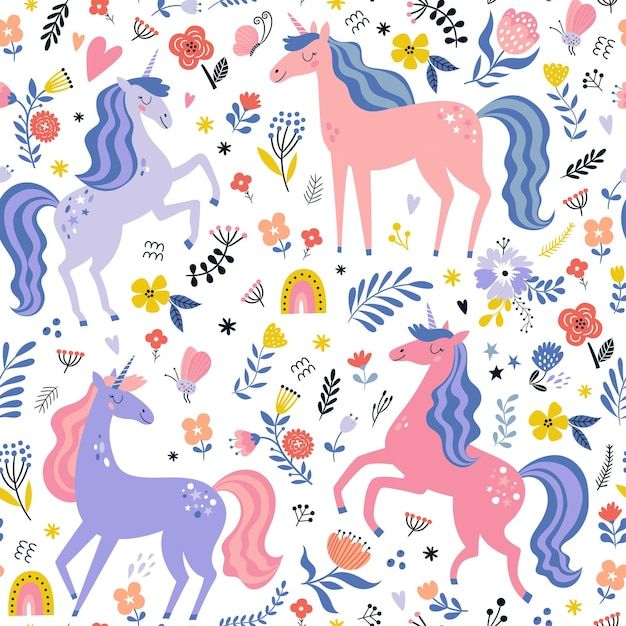
Contemporary unicorn patterns feature stylised horse silhouettes with a single spiralling horn, typically depicted in profile or three-quarter view. Manes and tails are rendered in multicolour gradients - commonly pink, lavender, gold, and turquoise. The surrounding composition includes clouds, stars, rainbows, hearts, and glitter-like dot elements. Holographic and iridescent surface effects are frequently referenced, though in flat print they are approximated through gradient fills and metallic ink choices. Pastel palettes dominate, though high-saturation rainbow versions are equally common.
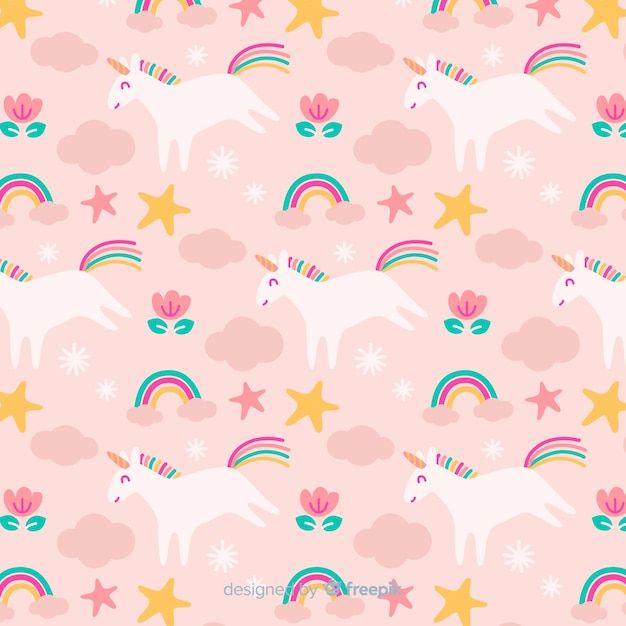
Unicorn patterns most commonly use tossed (scattered) repeat layouts, with unicorn figures, stars, clouds, and accessory motifs distributed across the surface. Single-motif centred repeats (block or full-drop) are used for simpler designs. Engineered placement prints - a single large unicorn motif on a garment panel - are common in children's apparel.
The dominant palette is pastel: soft pink, lavender, baby blue, mint, and gold. High-saturation rainbow versions - cycling through the full visible spectrum - are the secondary variant. Holographic shimmer effects (silver, pearl, or spectrum-shifting) are a characteristic feature of unicorn trend branding, translated into print as gradient fills or reflective inks. Black-background "dark unicorn" variants exist as an alternative aesthetic aimed at older audiences.
The unicorn has a documented history as a decorative motif from at least the 4th century BCE, appearing in ancient Greek natural history writing and medieval European heraldry and tapestry. In Western folklore, it was associated with purity and rarity. The contemporary commercial transformation - from mythological creature to pastel cartoon consumer icon - accelerated through children's media, particularly the My Little Pony franchise (which featured unicorn characters from its 1980s origins, relaunched 2010), and through the visual culture of Instagram and Pinterest.
The unicorn trend reached peak commercial saturation in 2016-2017, coinciding with widely shared viral food content ("unicorn toast," "unicorn frappuccino") and measurable Google Trends spikes in April 2017. Fashion industry engagement during the same period included the Moschino × My Little Pony runway collection at Milan Fashion Week (2017) and a Thom Browne Paris Fashion Week presentation (2018) featuring a staged unicorn figure. Cultural commentary has situated the trend within digital nostalgia, pastel-aesthetics branding, and LGBTQ visual culture (the rainbow as queer symbol intersecting with unicorn imagery).
By the early 2020s, the trend had passed peak novelty but the motif remained commercially standard in children's products and seasonal gifting lines.
The unicorn pattern draws on the mythological single-horned horse as a decorative motif, almost exclusively in its contemporary commercial form: a brightly coloured, pastel, or rainbow-palette character with a spiralling horn, flowing mane, and often surrounded by stars, clouds, rainbows, and sparkle elements.
Contemporary unicorn patterns feature stylised horse silhouettes with a single spiralling horn, typically depicted in profile or three-quarter view. Manes and tails are rendered in multicolour gradients - commonly pink, lavender, gold, and turquoise.
Novelty
Unicorn patterns most commonly use tossed (scattered) repeat layouts, with unicorn figures, stars, clouds, and accessory motifs distributed across the surface. Single-motif centred repeats (block or full-drop) are used for simpler designs.
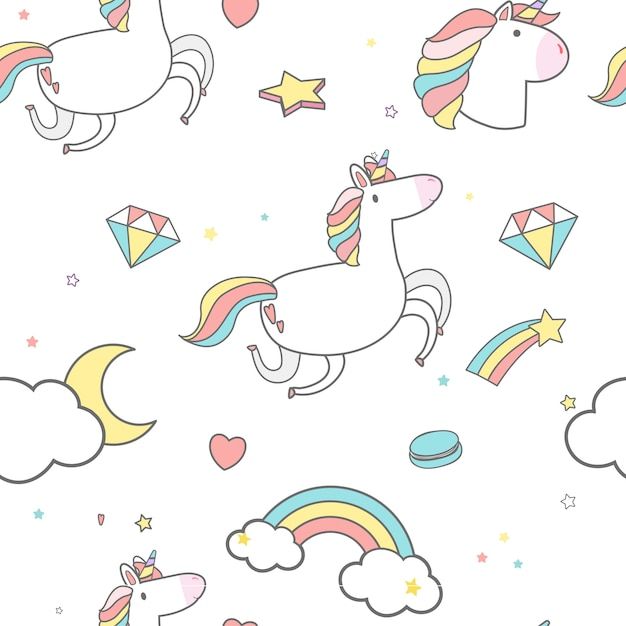
Unicorn figure (profile, rearing, or running pose) Spiralling horn (often gold or rainbow) Multicolour flowing mane and tail Rainbows (arc or full-spectrum bands) Stars, sparkles, glitter dots Clouds (white or pastel) Hearts, flowers, and magic wand elements Holographic or iridescent colour references
The dominant palette is pastel: soft pink, lavender, baby blue, mint, and gold. High-saturation rainbow versions - cycling through the full visible spectrum - are the secondary variant.
The unicorn has a documented history as a decorative motif from at least the 4th century BCE, appearing in ancient Greek natural history writing and medieval European heraldry and tapestry. In Western folklore, it was associated with purity and rarity.
Space Pattern