Loading
NEW DESIGNERS ADDED WEEKLY!
The best pattern designers.
Browse & hire professional surface pattern designers for fashion, textiles, interiors & product design.
Browse & hire professional surface pattern designers for fashion, textiles, interiors & product design.
We use cookies to improve your experience and understand how PatternDesigners is used.
Discover pattern styles, motifs & structures used throughout surface pattern design, with visual examples to help you recognise every pattern type.

Space patterns draw on astronomy and science-fiction aesthetics for decorative surface design, using the visual vocabulary of the night sky and space exploration as motif material. The category spans a wide stylistic range - from precise star-chart illustrations to cartoon rocket ships, from photographic nebula-inspired digital prints to mid-century retro-futurist designs. In surface pattern terms, "space" most directly refers to this astronomical and sci-fi thematic category, not to the concept of negative space or spatial grid systems in design.
Space patterns draw on astronomy and science-fiction aesthetics for decorative surface design, using the visual vocabulary of the night sky and space exploration as motif material. The category spans a wide stylistic range - from precise star-chart illustrations to cartoon rocket ships, from photographic nebula-inspired digital prints to mid-century retro-futurist designs. In surface pattern terms, "space" most directly refers to this astronomical and sci-fi thematic category, not to the concept of negative space or spatial grid systems in design.
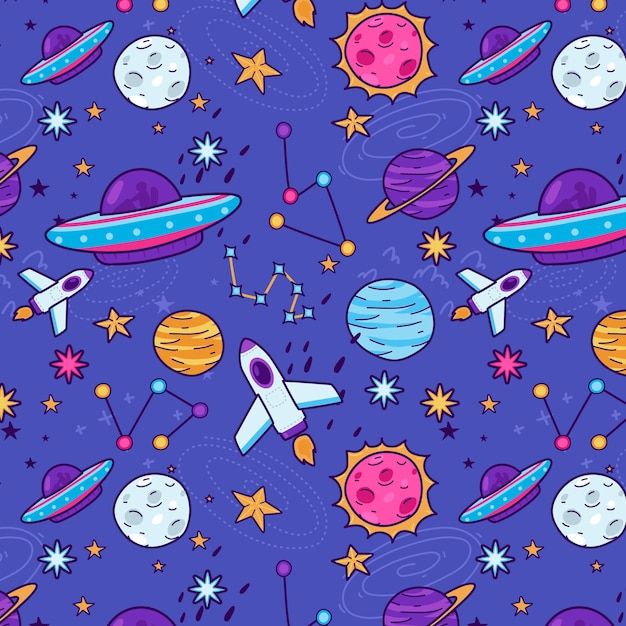
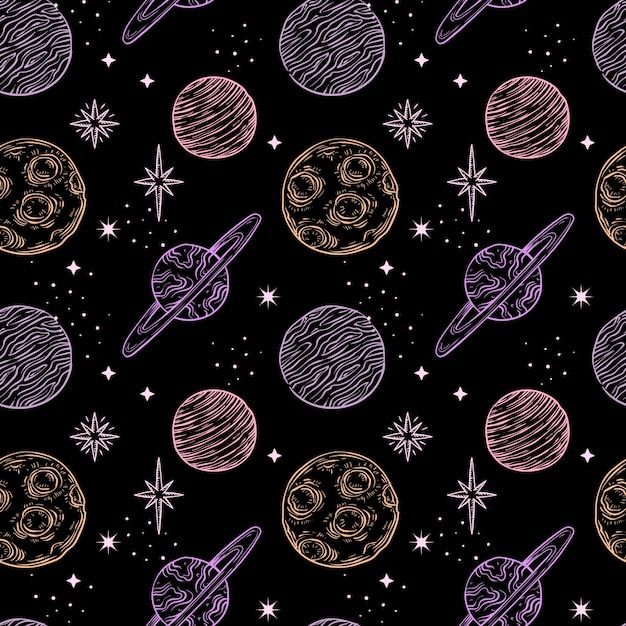
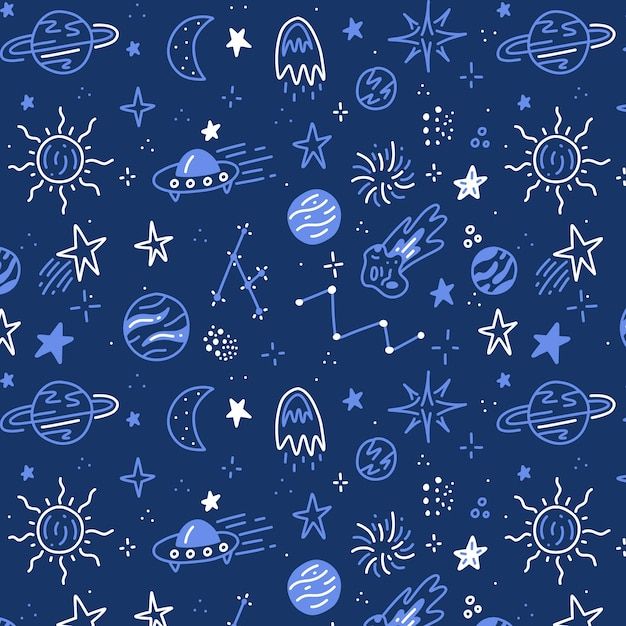
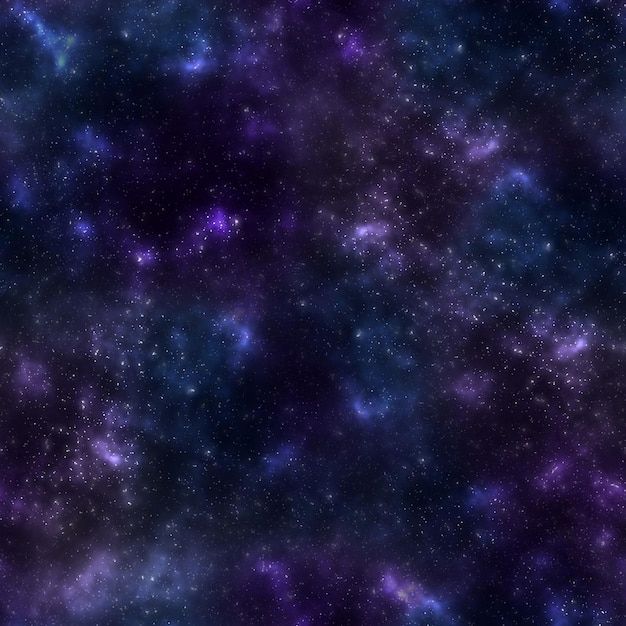
The typical space pattern is built on a dark background - deep navy, near-black, or dark violet - against which luminous, glowing, or metallic motif elements are arranged. Stars are the most versatile element: they appear as geometric asterisks, pointed five-pointed stars, small dot clusters, or constellation line drawings. Planets are depicted as spheres with rings (Saturn-type), colourful banding (Jupiter-type), or as simplified circular forms with crater texture. Rockets range from precise technical illustrations to cartoon 1950s bullet-nosed shapes. Astronauts and space capsules appear in more narrative conversational compositions. Nebula and galaxy imagery uses gradient colour fields, cloud-like swirling forms, and glowing particles.
Tossed (scattered) repeats are most common, distributing stars, planets, and other elements loosely across the surface. More structured compositions use half-drop or block arrangements for ordered star-field repeats. Placement prints featuring a central planet or rocket with surrounding star fields are used in children's apparel.
The dominant palette is dark: navy, black, or deep violet backgrounds with white, gold, silver, or iridescent motifs. Secondary palettes include deep teal, midnight blue, and dark plum. Children's variants often use brighter, more saturated element colours - vivid orange rockets, bright yellow stars - against the dark ground. Retro-futurist variants use 1950s-1960s Americana colour conventions: bold primaries, mid-century illustration styles. Contemporary variants may use neon or holographic elements. Glow-in-the-dark printing is technically compatible with this aesthetic and commercially used in children's bedlinen.
Space as a consumer design theme emerged with the post-WWII space race and accelerated through the 1960s. The distinctive retro-futurist rocket aesthetic - tapered bullet-nosed spacecraft, astronaut suits, ringed planets - derives from 1950s science fiction illustration and the visual culture of the Mercury/Apollo era. This aesthetic has been periodically revived, most recently in the nostalgia-driven design trends of the 2010s. Astronomical and constellation patterns have a longer heritage in scientific cartography and natural history illustration. The 88 officially recognised IAU constellations, and the zodiac 12, provide named pattern vocabularies used in more sophisticated or adult-market variants.
Space patterns draw on astronomy and science-fiction aesthetics for decorative surface design, using the visual vocabulary of the night sky and space exploration as motif material.
The typical space pattern is built on a dark background - deep navy, near-black, or dark violet - against which luminous, glowing, or metallic motif elements are arranged.
Novelty
Tossed (scattered) repeats are most common, distributing stars, planets, and other elements loosely across the surface. More structured compositions use half-drop or block arrangements for ordered star-field repeats.
Celestial and Novelty
The dominant palette is dark: navy, black, or deep violet backgrounds with white, gold, silver, or iridescent motifs. Secondary palettes include deep teal, midnight blue, and dark plum.
Space as a consumer design theme emerged with the post-WWII space race and accelerated through the 1960s. The distinctive retro-futurist rocket aesthetic - tapered bullet-nosed spacecraft, astronaut suits, ringed planets - derives from 1950s science fiction illustration and the visual culture of the Mercury/Apollo era.
Rocket Pattern, Star Pattern, Sky Pattern, and Retro Pattern