Loading
NEW DESIGNERS ADDED WEEKLY!
The best pattern designers.
Browse & hire professional surface pattern designers for fashion, textiles, interiors & product design.
Browse & hire professional surface pattern designers for fashion, textiles, interiors & product design.
We use cookies to improve your experience and understand how PatternDesigners is used.
Explore the worlds leading brands, studios & manufacturers that commission, license & produce surface pattern design across fashion, homeware, stationery & more.

Hermès International S.A. is a French luxury goods company founded in Paris in 1837 by Thierry Hermès as a harness and saddlery workshop. The house remained in continuous family ownership across six generations; the H51 family holding controls 66.72% of shares. In 2024, Hermès reported €15.2 billion in sales and €4.6 billion in net income at a 40.5% operating margin - the highest margin in the global luxury sector. In April 2025, Hermès surpassed LVMH to become the most valuable luxury goods group in the world by market capitalisation. It employs approximately 25,000 people, including 7,000 craftsmen and 15,000 employees in France.
Hermès design direction is governed by artistic continuity under the Dumas family, with Pierre-Alexis Dumas serving as artistic director. Ready-to-wear women's has been led by successive creative directors: Jean-Paul Gaultier (2003-2010), Christophe Lemaire (2010-2014), Nadège Vanhée-Cybulski (2014-present). Grace Wales Bonner was announced as men's ready-to-wear creative director in October 2025, with her first collection due January 2027. The scarf programme operates on its own creative cycle independent of runway collections.
Hermès operates 16 product divisions. By revenue: Leather goods and saddlery (42.6%), Ready-to-wear, footwear, and accessories (29%), Silk and textiles (6.3%), Watches (3.8%), Perfumes (3.5%), and Other including tableware, home, and jewellery (14.8%). Production is maintained across 60 production sites, with the majority in France. The company was admitted to the CAC 40 in June 2018 and the Euro Stoxx 50 in December 2021. WIPO ranked Hermès 7th globally for industrial design registrations in 2021.
The house has maintained a strict no-licensing policy throughout its history - all products are designed, manufactured, and sold under direct Hermès control. Subsidiary acquisitions have extended this model: John Lobb Bootmaker Paris (acquired 1976), Saint-Louis crystal (founded 1586, acquired 1989), Puiforcat goldsmith (full control 1993). petit h, launched in 2010, operates as an internal creative lab producing objects from offcut materials across Hermès divisions combined with Saint-Louis crystal and Puiforcat silverwork.
Leather goods and saddlery are the founding and largest category: Birkin bag (1984, created during a conversation between CEO Jean-Louis Dumas and Jane Birkin), Kelly bag (1950s, named after Grace Kelly), Evelyne bag (featuring a perforated "H" motif as a designed surface element), and Bolide. Ready-to-wear is structured across two collections annually plus a men's line. Silk and textiles encompasses the carré de soie scarves, silk ties, and derivative products. Watches (Cape Cod, Arceau, Slim d'Hermès), perfumes, and Maison d'Hermès (home: table services, household linens, outdoor textiles, decorations, furniture, carpets) complete the range.
Hermès operates exclusively through its own retail network and does not license. All products are sold through Hermès-owned boutiques or authorised dealer relationships under close supervision. The no-licensing model is a strategic differentiator from LVMH's portfolio model and has been maintained as a condition of family ownership and brand integrity. Hermès boutique architecture is treated as part of the brand's design output, with commissioned structures in Seoul, Shanghai, and New York among documented examples.
Hermès occupies the apex of the global luxury market, defined by artisanal production, long lead times, and deliberate scarcity. Its competitive position is protected by the no-licensing model, French manufacturing concentration, and multi-generational brand continuity. The brand avoids the mass-luxury positioning of LVMH's volume brands; the Birkin and Kelly bags are functionally rationed through purchase history requirements. Hermès stores temporarily closed in Russia in March 2022 following the invasion of Ukraine.
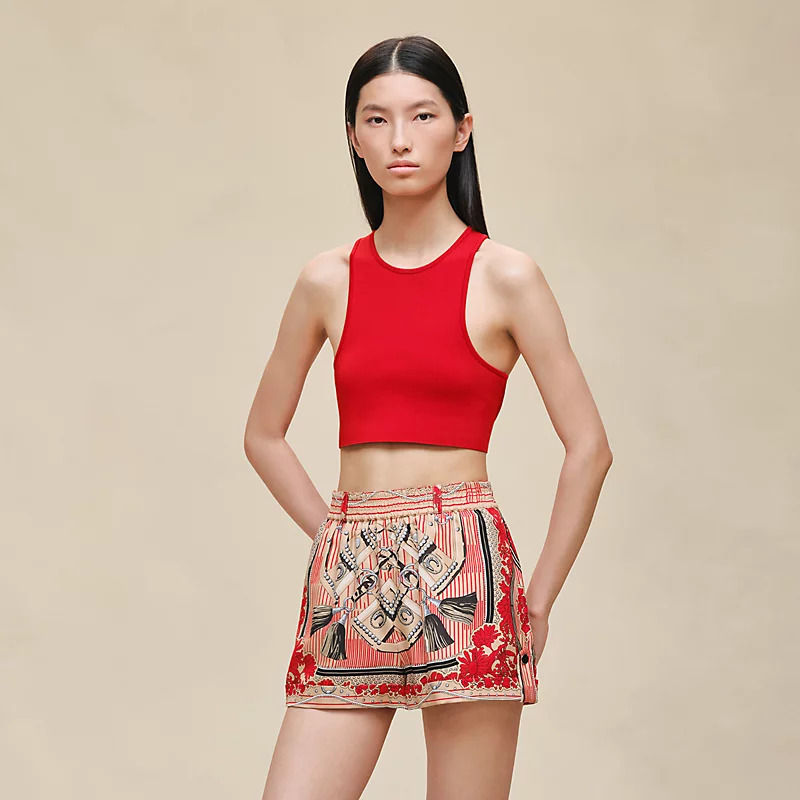
The Hermès carré de soie is one of the most documented and continuously produced surface pattern objects in the world.
Scale and production: The first carré was produced in 1937 ("Jeu des omnibus et dames blanches"). Since then, Hermès has produced more than 3,000 unique designs. Two new collections are released annually, supplemented by reprints and limited editions. Each 90 × 90 cm scarf weighs 79 grams and requires the silk from 300 mulberry moth cocoons. Production is handled by Holding Textile Hermès (HTH) at Pierre-Bénite near Lyon, a facility of approximately 800 people, in a silk-weaving and screen-printing region where Hermès has maintained its textile production for decades.
Surface design process: Each carré design is developed by dedicated in-house designers, with individual designs taking up to 18 months to complete. Colours number approximately 70,000 choices across the archive. Screen printing is the primary production method; in 2020, Hermès introduced a secret double-sided printing technique that produces a scarf with a distinct colourway on each face - a significant technical innovation for the format. The "Brides de Gala" design (1957) is among the most reproduced in the archive, produced more than 70,000 times and, at peak commercial periods, selling at the rate of one every 25 seconds globally.
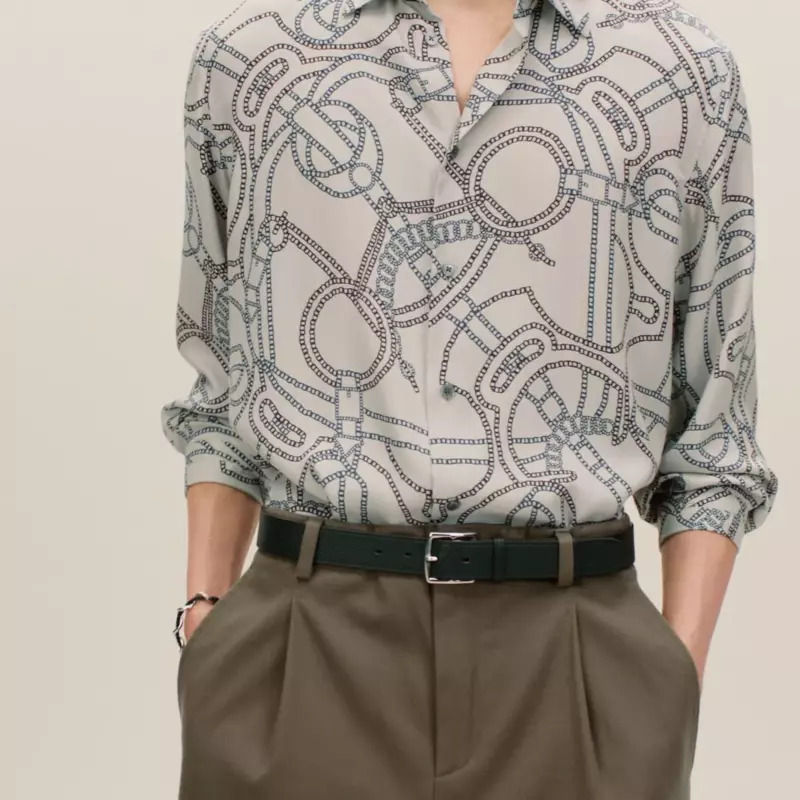
Motif vocabulary: Hermès scarves draw on a consistent vocabulary of equestrian, botanical, cartographic, and cultural motifs. Tuareg traditional motifs have been incorporated across the scarf range and other product categories. The Chaîne d'ancre bracelet (designed 1938 by Robert Dumas) is a widely recognised motif derived from equestrian chain links, extended across jewellery, scarves, and home objects.
Home textiles: Maison d'Hermès produces household linens, outdoor textiles, and carpets - additional surface pattern categories where Hermès applies its design language to domestic contexts.
A. is a French luxury goods company founded in Paris in 1837 by Thierry Hermès as a harness and saddlery workshop. 72% of shares. 5% operating margin - the highest margin in the global luxury sector.
The Hermès carré de soie is one of the most documented and continuously produced surface pattern objects in the world. Scale and production: The first carré was produced in 1937 ("Jeu des omnibus et dames blanches"). Since then, Hermès has produced more than 3,000 unique designs.
Leather goods and saddlery are the founding and largest category: Birkin bag (1984, created during a conversation between CEO Jean-Louis Dumas and Jane Birkin), Kelly bag (1950s, named after Grace Kelly), Evelyne bag (featuring a perforated "H" motif as a designed surface element), and Bolide.
Hermès occupies the apex of the global luxury market, defined by artisanal production, long lead times, and deliberate scarcity. Its competitive position is protected by the no-licensing model, French manufacturing concentration, and multi-generational brand continuity.
Hermès operates exclusively through its own retail network and does not license. All products are sold through Hermès-owned boutiques or authorised dealer relationships under close supervision.
Hermès operates 16 product divisions. 8%). Production is maintained across 60 production sites, with the majority in France. The company was admitted to the CAC 40 in June 2018 and the Euro Stoxx 50 in December 2021. WIPO ranked Hermès 7th globally for industrial design registrations in 2021.
France