
We use cookies to improve your experience and understand how PatternDesigners is used.
J. Press is an American Ivy League menswear brand founded in 1902 by Latvian immigrant Jacobi Press on Yale University's campus in New Haven, Connecticut. The brand built its reputation through the 1920s as the preferred tailor of a culturally distinguished clientele - Duke Ellington, Cary Grant, and Robert Frost are documented patrons. The brand remains committed to a classical, non-trend-driven preppy aesthetic; it has not materially changed its core offering since founding. In 1986, J. Press was acquired by the Japanese apparel company Onward Kashiyama (previously its Japanese licensee for 14 years) and is now part of the Onward Group (Onward Holdings, Ltd.). In 2025, Jack Carlson - rower, author of Rowing Blazers, and a prominent figure in the American prep revival - was appointed creative director. J. Press currently operates three US stores: New Haven (flagship, rebuilt at the historic Elm Street site for the 120th anniversary in 2022), New York City (at the Yale Club, Midtown Manhattan), and Washington D.C.
Jack Carlson (appointed 2025) brings the prep revival lens cultivated through his Rowing Blazers brand and book to J. Press. The brand's design direction has historically changed slowly and deliberately - the three-button sack, the Shaggy Dog sweater, the madras jacket, and the repp tie remain the core vocabulary. Carlson has spoken of re-opening a Harvard-area store as a priority, consistent with a wider revival of campus-based physical retail. The brand's Japanese operations (roughly six times larger than the US) presumably sustain a parallel design and curation programme under Onward Group management.
J. Press was founded by Jacobi Press, who had immigrated from Latvia and trained in his uncle's custom tailoring business before opening his New Haven shop. Irving E. Press, Jacobi's son, led the company through its post-war heyday and introduced signature items including the Shaggy Dog Shetland sweater. In 1974, the Press family licensed the brand for Japan - the first American brand to be licensed in Japan. Japanese licensed distribution has grown to be approximately six times larger than the American business. In 1986, Onward Kashiyama acquired J. Press outright, ending Press family ownership. A younger-skewing sub-line, J. Press York Street (designed by Shimon and Ariel Ovadia of Ovadia & Sons), operated from 2013 on Bleecker Street, New York, before being discontinued in 2015 and folded into J. Press Blue. The New Haven flagship was rebuilt and reopened in June 2022 at its historic Elm Street location.
J. Press operates three US retail stores. The Japanese market - accessed via a licensing deal first granted in 1974, then converted to outright ownership in 1986 - is by far the larger commercial operation. J. Press is part of Onward Holdings, Ltd., a major Japanese apparel conglomerate. No details about current licensing terms, wholesale, or e-commerce scale are documented in the available source.
J. Press occupies the most traditional and conservative segment of the American menswear market - distinctly to the right of Brooks Brothers on the spectrum of Ivy League style. Its customer is described in The Official Preppy Handbook (1980) as men who "feel Brooks Brothers is too trendy." The brand's US retail presence is minimal (three stores) but its Japanese licensed business is substantially larger and its cultural authority as an Ivy League heritage institution remains intact. The appointment of Jack Carlson in 2025 signals a deliberate effort to activate the brand's prep credibility with a new generation.
J. Press is a concentrated archive of Ivy League surface pattern and textile tradition.
Neckties carry three classic pattern types that define American prep menswear: repp stripe (diagonal woven stripe in institutional colours), foulard (small-scale geometric repeat print), and paisley (curved teardrop motif). These tie patterns are among the most durable pattern typologies in menswear.
Indian madras - the seasonal signature cloth - is one of the defining surface pattern expressions of American preppy summer style: hand-woven, bleeding-dye plaid/check/stripe combinations from South India that carry both cultural heritage and casual colour.
Herringbone tweed overcoats represent one of the most recognisable woven surface structures in tailoring; J. Press's documented use of herringbone in Chesterfield-cut overcoats is a textbook example of pattern applied through cloth construction rather than print.
Shetland knitwear (Shaggy Dog sweaters) uses the textured loop-yarn construction of traditional Scottish island knitting - a surface texture rather than print pattern, but a core part of the brand's surface language.
Institutional stripe and crest motifs on scarves and ties for Ivy League schools are examples of graphic identity applied to woven textile surfaces - a form of licensed pattern application.
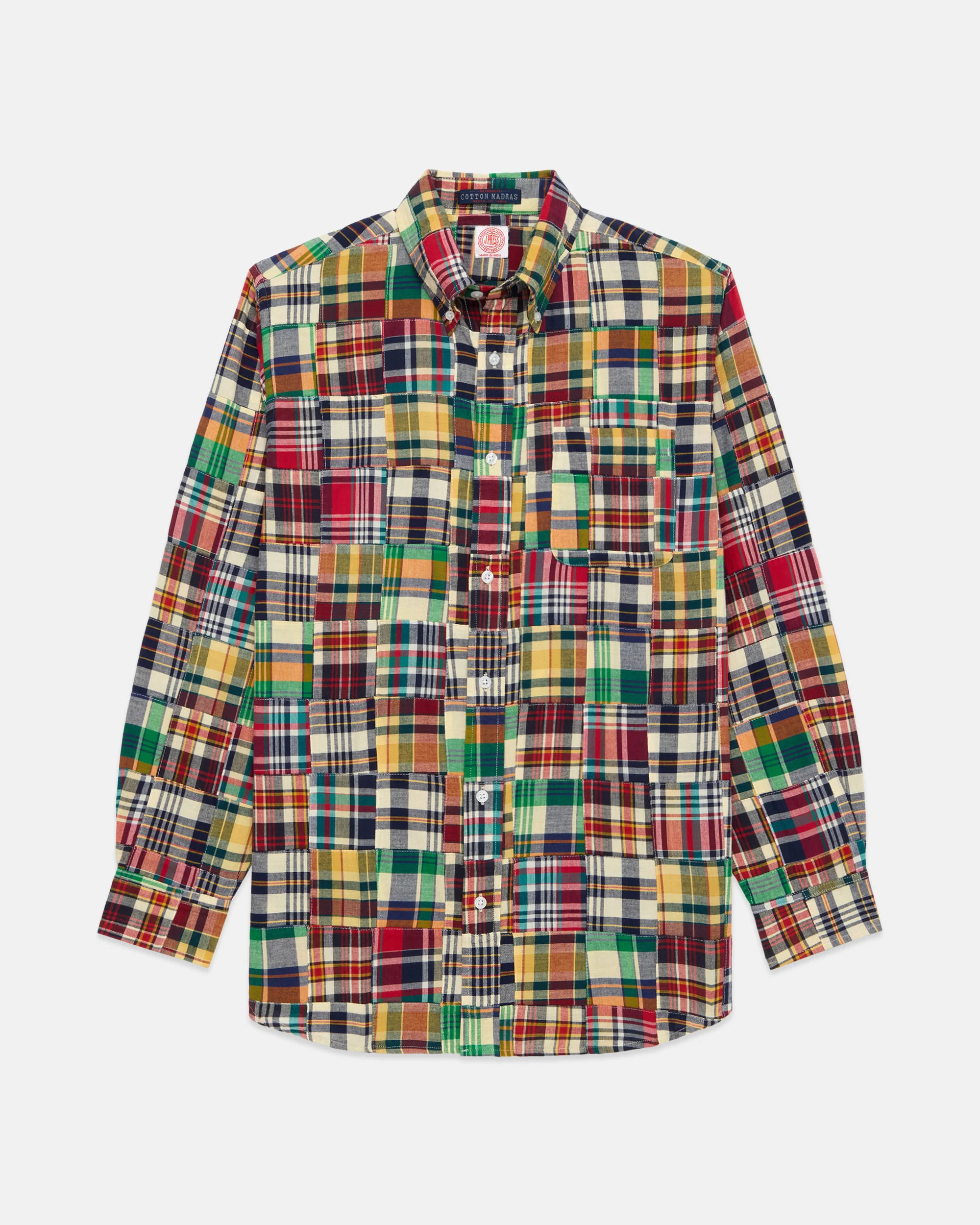
J. Press is an American Ivy League menswear brand founded in 1902 by Latvian immigrant Jacobi Press on Yale University's campus in New Haven, Connecticut.
J. Press is a concentrated archive of Ivy League surface pattern and textile tradition. Neckties carry three classic pattern types that define American prep menswear: repp stripe (diagonal woven stripe in institutional colours), foulard (small-scale geometric repeat print), and paisley (curved teardrop motif).
g. Yale Skull and Bones) Indian madras jackets - seasonal colour-blocked and tartan-adjacent woven cloth from India; a signature product "Shaggy Dog" Shetland sweaters - textured knitwear; a J.
J. Press occupies the most traditional and conservative segment of the American menswear market - distinctly to the right of Brooks Brothers on the spectrum of Ivy League style.
J. Press operates three US retail stores. The Japanese market - accessed via a licensing deal first granted in 1974, then converted to outright ownership in 1986 - is by far the larger commercial operation. J. , a major Japanese apparel conglomerate.
J. Press was founded by Jacobi Press, who had immigrated from Latvia and trained in his uncle's custom tailoring business before opening his New Haven shop. Irving E. Press, Jacobi's son, led the company through its post-war heyday and introduced signature items including the Shaggy Dog Shetland sweater.
United States