Loading
NEW DESIGNERS ADDED WEEKLY!
The best pattern designers.
Browse & hire professional surface pattern designers for fashion, textiles, interiors & product design.
Browse & hire professional surface pattern designers for fashion, textiles, interiors & product design.
We use cookies to improve your experience and understand how PatternDesigners is used.
Explore the worlds leading brands, studios & manufacturers that commission, license & produce surface pattern design across fashion, homeware, stationery & more.

Lanvin is a French luxury fashion house founded in 1889 by Jeanne Lanvin (1867-1946) at 16 Rue Boissy-d'Anglas in Paris - making it the oldest French fashion house still in operation. Jeanne Lanvin began as a milliner on Rue du Marché Saint-Honoré from 1885, expanded into children's clothing in 1908 after dressing her daughter Marguerite, and joined the Chambre Syndicale de la Couture in 1909. She opened an interior design store in collaboration with Armand-Albert Rateau in 1920. A dye factory opened in Nanterre in 1923 to produce exclusive colours, including the house's signature blue. Lanvin Parfums was founded in 1924; the fragrance Arpège followed in 1927, created to mark Marguerite's 30th birthday. The house logo - a figurative illustration of Jeanne Lanvin with her daughter at a costume ball - was drawn by Paul Iribe in 1923 from a 1907 photograph. Lanvin is now a subsidiary of Lanvin Group, listed on the New York Stock Exchange (NYSE: LANV) and controlled by Fosun International (Shanghai).
Peter Copping was announced as Lanvin's artistic director on June 27, 2024 (effective September 2024), leading womenswear and menswear. Copping previously led Balenciaga's return to Haute Couture, served as creative director at Nina Ricci (cited in source; Wikipedia also indicates Oscar de la Renta). His appointment follows Bruno Sialelli's departure in April 2023 after four years. The house has had seven creative directors since Elbaz's 2015 departure, reflecting structural instability at the creative level under successive ownership changes.
Lanvin's post-founder history passed through family ownership (Marguerite de Polignac until 1958, then the Lanvin family), multiple fashion director tenures (Jules-François Crahay 1964-1984; Maryll Lanvin 1981-1989), a Midland Bank stake (1989), and L'Oréal ownership from 1990 to 2001. Following L'Oréal's exit, Harmonie S.A. - led by Taiwanese media magnate Wang Shaw-lan - acquired Lanvin in August 2001. Wang bought out the other Harmonie investors in 2003 and held the stake until 2018. Fosun International (Shanghai-based conglomerate) became the owner in February 2018, acquiring both Wang's 75% stake and Ralph Bartel's 25% stake. Fosun's fashion subsidiary was renamed Lanvin Group in October 2021 and listed on NYSE in 2023, valued at $1.5 billion. The group also owns Sergio Rossi (footwear), Wolford (Austrian luxury legwear), St. John Knits (US knitwear), and Caruso (Italian tailoring).
Creative directors since 2001:
Current CEO: Barbara Werschin (2026-present), succeeding Siddhartha Shukla (December 2021-March 2026).
Lanvin produces womenswear, menswear, shoes (including the urban sneaker line introduced by Lucas Ossendrijver, AW2006), accessories, leather goods, jewellery, eyewear, and kidswear. Ready-to-wear is the primary commercial category. Key category notes:
Lanvin operates flagship retail in Paris, New York (first US boutique opened December 4, 2009, in Bal Harbour, Florida), and major international capitals. The Japan license through Itochu (Joix Corporatic from 2005) was a significant revenue operation - with approximately $280 million in annual Lanvin-branded sales from Japan in 2007, exceeding Lanvin's own direct revenue. The fragrance operations (Arpège and others) were sold to Interparfums in 2007, ending Lanvin's direct control of its own perfume business. Lanvin Group's NYSE listing (2023) grouped Lanvin alongside Sergio Rossi, Wolford, St. John Knits, and Caruso as a multi-brand luxury vehicle. The H&M design collaboration (Winter 2010) was among the earlier high-profile mass-fashion designer collaborations of that period, making Lanvin accessible at H&M price points globally.
Lanvin's defining modern commercial era was Alber Elbaz's tenure (2001-2015). Elbaz rebuilt the house's identity around emotional, technically precise womenswear - draped jersey silhouettes, embellished eveningwear, and a consistent visual language that made Lanvin one of the most critically admired and commercially growing mid-luxury houses in Paris. His departure in October 2015 marked a structural break: four subsequent creative directors in nine years have not restored comparable commercial momentum. Revenue reached €203 million in 2011 during Elbaz's period; post-2015 performance has not been disclosed at that level. The Fosun ownership, NYSE listing (2023), and appointment of Peter Copping (June 2024) represent the current attempt to stabilise the house's creative and commercial direction. Japan remains a significant revenue channel via the Itochu license: in 2007 that license generated approximately $280 million in Lanvin-branded sales - more than the house earned directly. The perfume business was sold to Interparfums in 2007.
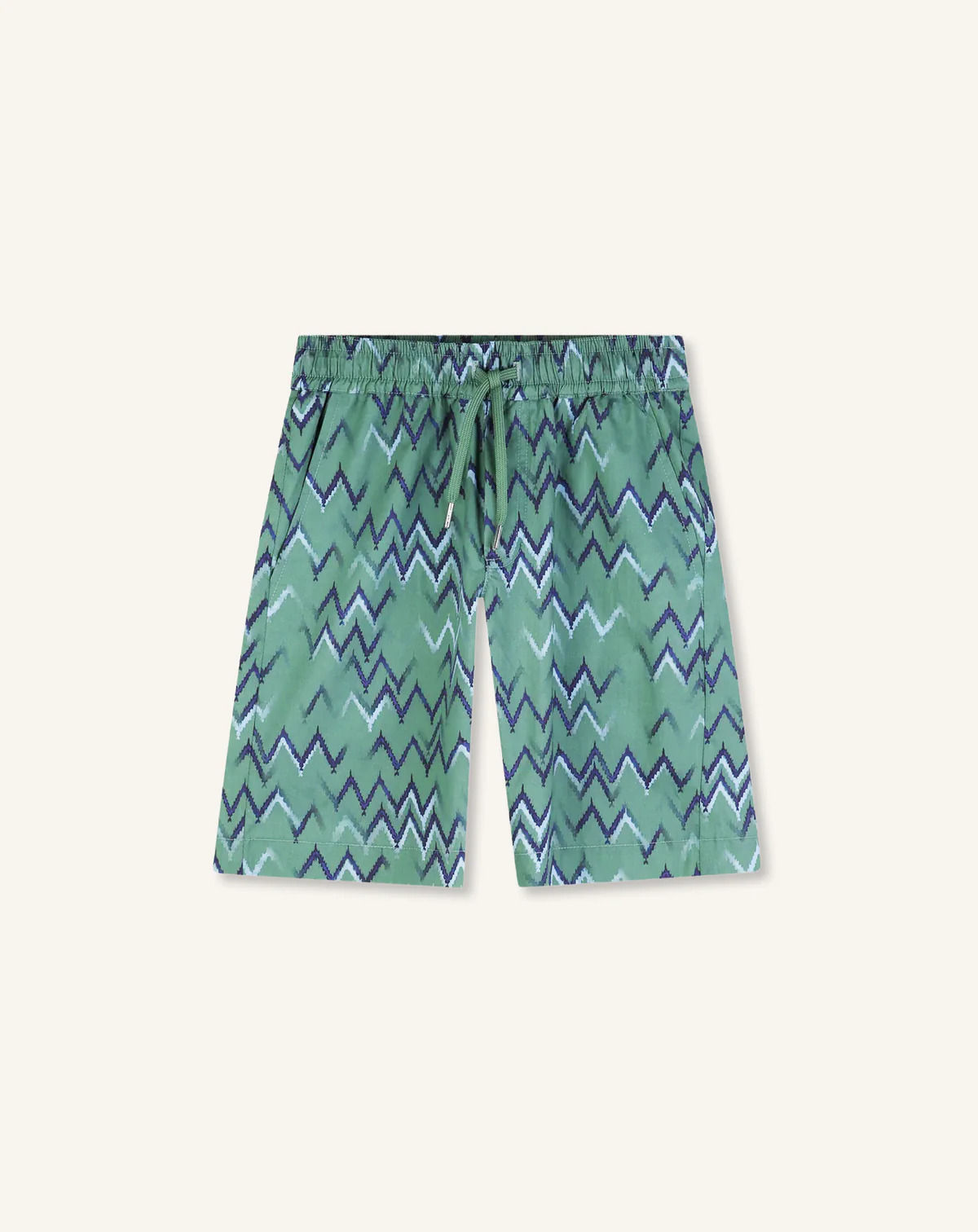
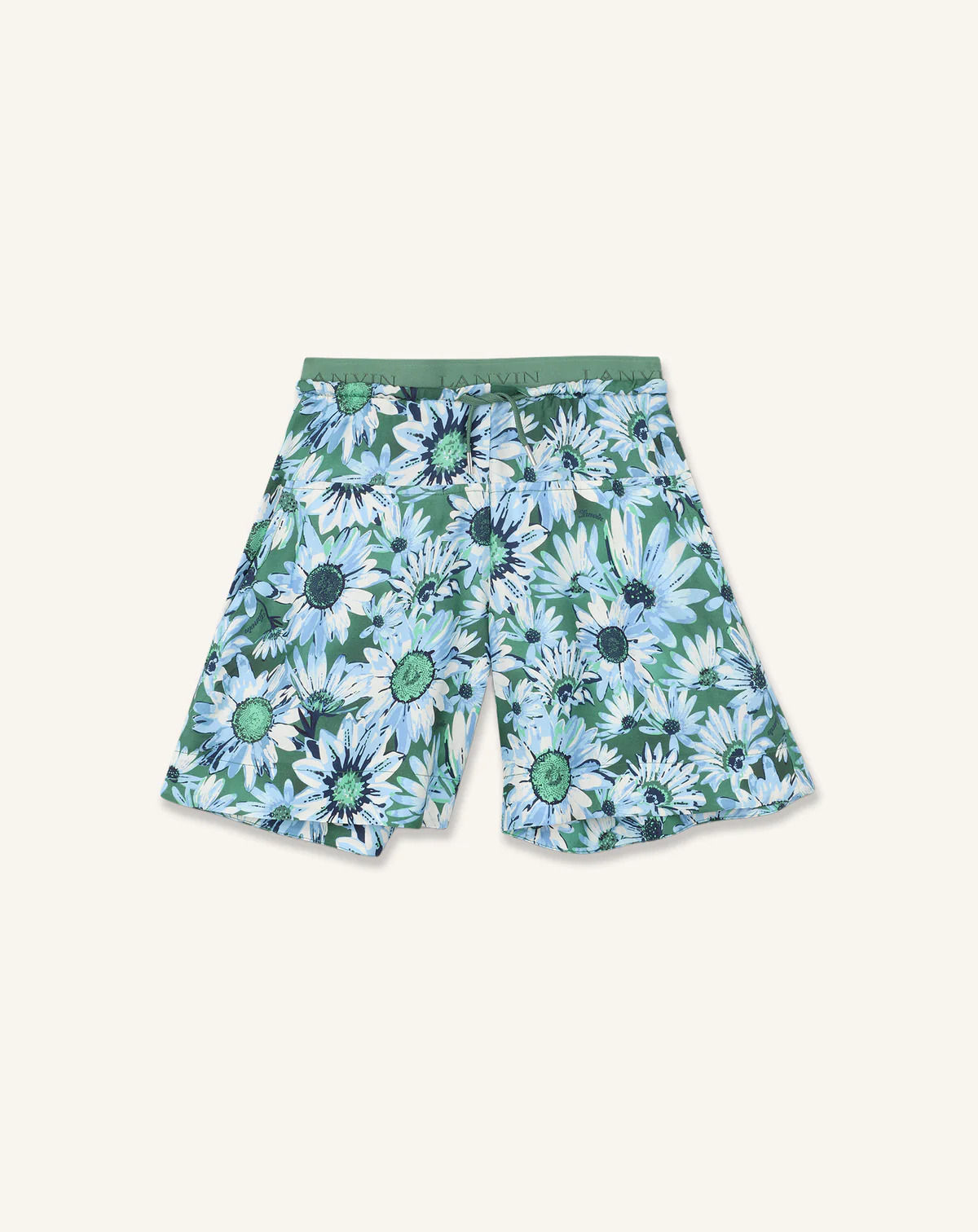
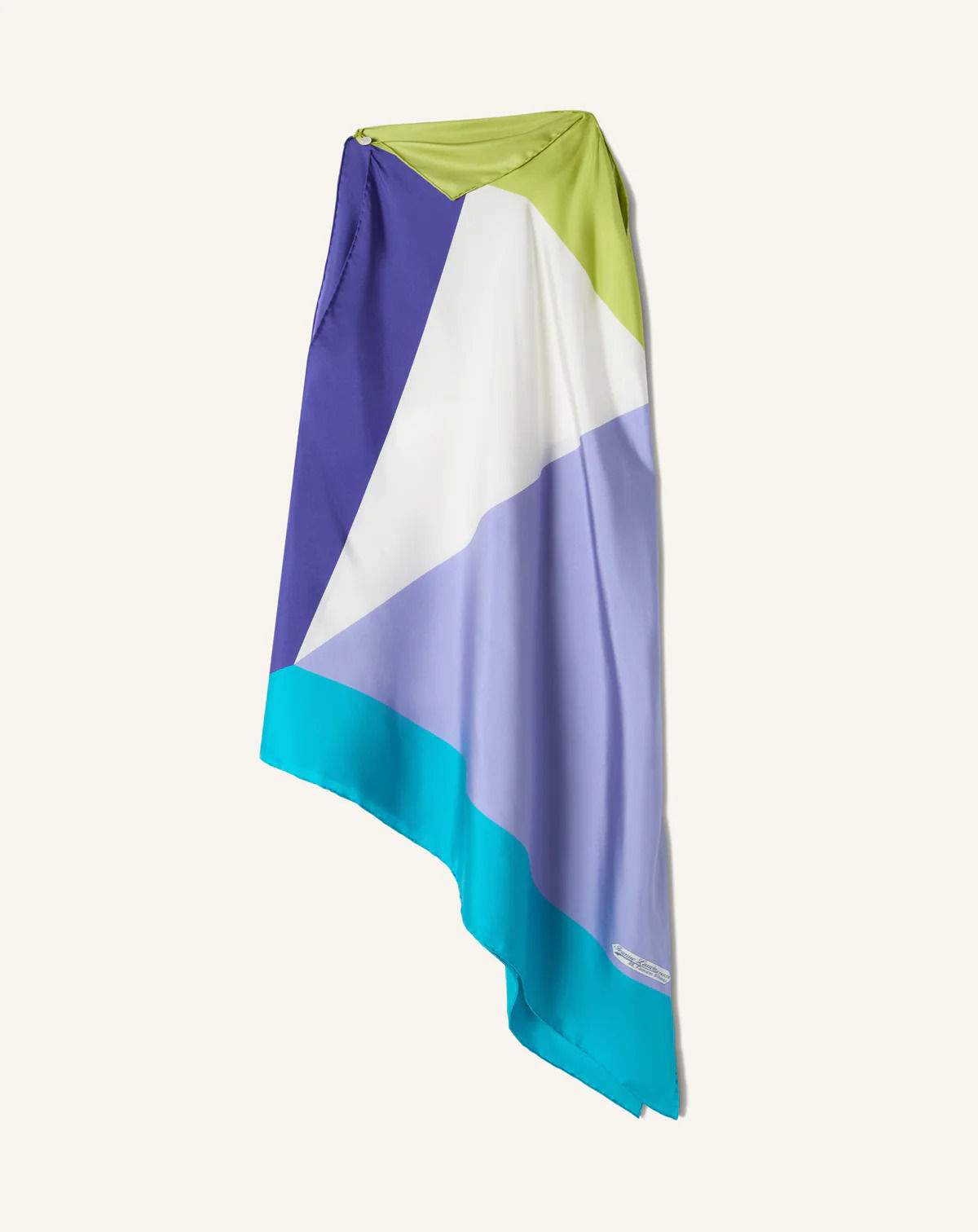
Lanvin is one of French couture's most historically significant sources for applied surface pattern design on luxury garments.
Jeanne Lanvin's embroidery is the foundational surface design identity of the house. Her robes de style - wide-skirted, interwar couture gowns - were distinguished by densely embroidered surfaces drawing on Byzantine, folk textile, and botanical sources. The embroidery work was among the most technically elaborate produced in Paris during the 1920s and 1930s.
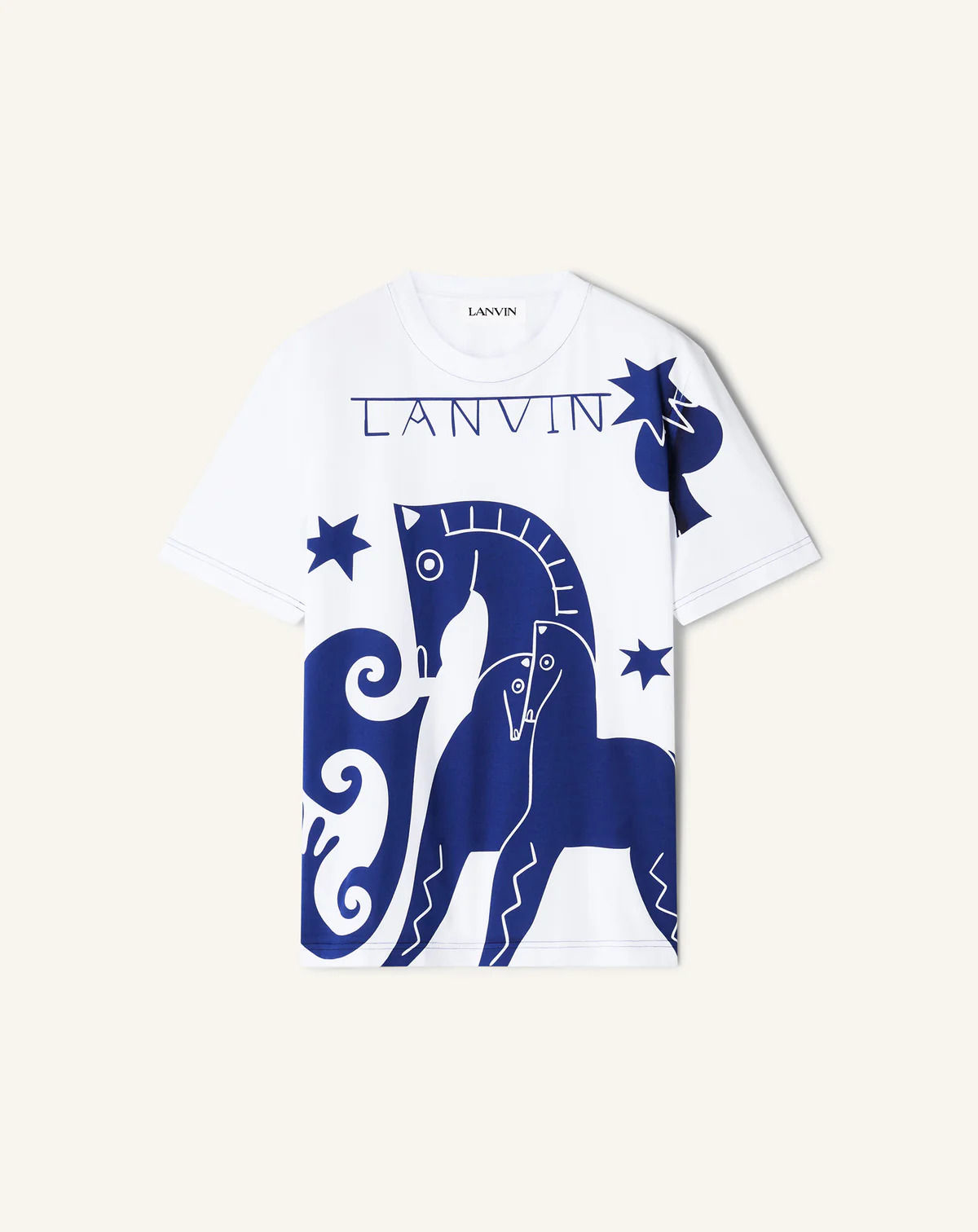
"Lanvin blue" is the house's proprietary colour, developed in 1923 via the Nanterre dye factory. Alber Elbaz reinforced this colour identity when he introduced forget-me-not flower packaging in 2006, citing Lanvin's favourite shade. The blue is described in source as "the forget-me-not flower color" - a specific saturated blue associated with the brand across fabric, packaging, and graphic identity.
Alber Elbaz's print direction (2001-2015) applied sophisticated surface pattern to modern luxury silhouettes - his draped jersey collections used large-scale abstract prints, applied embellishment, and graphic surface treatments that referenced the house's interwar embroidery heritage while speaking to contemporary luxury fashion.
The Lanvin logo (Paul Iribe, 1923) - a figurative illustrative mark depicting a mother-and-daughter - is a surface design motif applied to accessories, bags, and garments. It is an unusual luxury brand mark: a narrative illustration rather than an abstract monogram, giving Lanvin-branded objects a different surface graphic vocabulary from GG-, LV-, or CD-style logotype patterns.
Lanvin is a French luxury fashion house founded in 1889 by Jeanne Lanvin (1867-1946) at 16 Rue Boissy-d'Anglas in Paris - making it the oldest French fashion house still in operation.
Lanvin is one of French couture's most historically significant sources for applied surface pattern design on luxury garments. Jeanne Lanvin's embroidery is the foundational surface design identity of the house.
Lanvin produces womenswear, menswear, shoes (including the urban sneaker line introduced by Lucas Ossendrijver, AW2006), accessories, leather goods, jewellery, eyewear, and kidswear. Ready-to-wear is the primary commercial category.
Lanvin's defining modern commercial era was Alber Elbaz's tenure (2001-2015).
Lanvin operates flagship retail in Paris, New York (first US boutique opened December 4, 2009, in Bal Harbour, Florida), and major international capitals.
Lanvin's post-founder history passed through family ownership (Marguerite de Polignac until 1958, then the Lanvin family), multiple fashion director tenures (Jules-François Crahay 1964-1984; Maryll Lanvin 1981-1989), a Midland Bank stake (1989), and L'Oréal ownership from 1990 to 2001. A.
France