Loading
NEW DESIGNERS ADDED WEEKLY!
The best pattern designers.
Browse & hire professional surface pattern designers for fashion, textiles, interiors & product design.
Browse & hire professional surface pattern designers for fashion, textiles, interiors & product design.
We use cookies to improve your experience and understand how PatternDesigners is used.
Explore the worlds leading brands, studios & manufacturers that commission, license & produce surface pattern design across fashion, homeware, stationery & more.

Mikimoto is a Japanese luxury jewellery company founded in 1893 by Kokichi Mikimoto, who successfully created the world's first cultured pearls that year. The brand is best known for its pearl jewellery - necklaces, rings, earrings, and accessories - and has been producing cultured pearl jewellery for over 130 years. From its origins in Japan, Mikimoto has grown into a global luxury jewellery house with retail presence across major international markets. The brand also produces diamond jewellery (establishing foundations in diamond gem processing from 1911) and coloured stone jewellery. Mikimoto describes its craft as rooted in Japanese artistry and shaped by international cultural influences.
The source does not document individual designers or a named creative director. Mikimoto's design philosophy is characterised as a continuous tradition of translating the allure of pearls into jewellery, with the stated ambition to "update the tradition of beauty to ensure our products are always new and exciting." The brand's aesthetic is anchored in the material qualities of the pearl - lustre, roundness, graduated scale - applied through high-craft manufacturing rooted in Japanese artisanal tradition.
Kokichi Mikimoto founded the brand in 1893 following his successful development of the cultured pearl technique - the controlled insertion of an irritant into an oyster to stimulate nacre production, creating a commercially reproducible pearl. The technique transformed the pearl industry globally: previously, natural pearls were a luxury available only through rare finds; Mikimoto's cultured method made pearl jewellery accessible as a commercial product category.
Key moments documented in the source:
The company maintains active sustainability and environmental programmes focused on ocean preservation and the pearl industry, as well as social contributions through support for marine research and artistic and cultural activities.
Mikimoto operates luxury retail boutiques in major international markets. The brand's ocean sustainability programme focuses on preserving the marine environments where pearl oysters are cultivated - an environmental concern that is also a supply chain concern, since pearl cultivation depends on clean ocean conditions. The brand supports marine research and artistic and cultural activities as part of its social contribution programme. No licensing deals or wholesale distribution are documented in the available source, consistent with the direct retail model typical of luxury jewellery houses.
Mikimoto occupies the premium and luxury tier of the global jewellery market, competing with international luxury jewellery houses. Its position is anchored by the cultural authority of having invented the cultured pearl industry - a heritage claim that is both factually singular and commercially powerful. Pearl jewellery at the Mikimoto level commands luxury pricing and targets a consumer who values both the product's technical provenance and its aesthetic refinement. The brand's pearl necklaces are described in source as "loved across all generations and genders." Diamond and coloured stone categories extend Mikimoto beyond pearl into the broader fine jewellery market.
Mikimoto's relevance to surface pattern design is indirect but structurally significant: the pearl is both an object of luxury adornment and a recurring motif in the decorative arts and surface design tradition.
Pearl as surface ornament - throughout the history of textile and fashion design, pearl - whether real or simulated - has been one of the most frequently referenced and applied surface embellishment materials. Pearl beading, pearl-effect finishes, and pearl motif prints are recurrent in luxury and premium fashion. Mikimoto, as the brand that invented and perfected the cultured pearl, occupies the apex of this material tradition. Fashion designers have used real Mikimoto pearls in couture embellishment and have referenced the aesthetic of pearl strings in print, embroidery, and surface treatment design.
Nacre texture as surface reference - nacre (the iridescent biological coating of cultured pearls) is a distinctive surface material: luminous, iridescent, with a soft reflective quality that differs from metallic or matte surfaces. This surface quality has been widely referenced in fashion textiles - iridescent fabrics, pearl-finish coatings, and luminous surface treatments in womenswear all reference or approximate the nacre aesthetic.
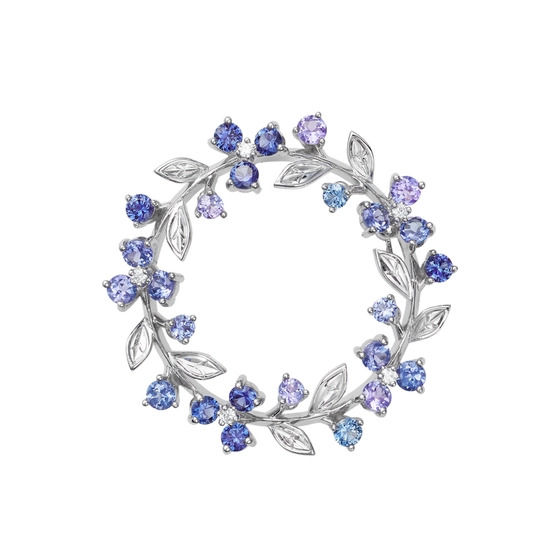
Jewellery design as applied ornament - Mikimoto's jewellery pieces, particularly elaborate necklaces and brooches, are designed objects with complex compositional structures: clusters, graduated forms, floral and organic arrangements of pearls and other gems. These design structures - arrangements of elements across a surface - share formal relationships with repeat pattern composition, particularly in decorative arts and accessories.
Craftmanship and cultural identity - Mikimoto describes its craftsmanship as "artistry born in Japan and shaped by influences from different cultures around the world." This international-influenced Japanese aesthetic is directly relevant to the decorative arts context of surface pattern design, particularly in relation to Japanisme - the influence of Japanese aesthetics on Western decorative arts - which is a historical thread running through pattern design from William Morris onward.
Mikimoto is a Japanese luxury jewellery company founded in 1893 by Kokichi Mikimoto, who successfully created the world's first cultured pearls that year. The brand is best known for its pearl jewellery - necklaces, rings, earrings, and accessories - and has been producing cultured pearl jewellery for over 130 years.
Mikimoto's relevance to surface pattern design is indirect but structurally significant: the pearl is both an object of luxury adornment and a recurring motif in the decorative arts and surface design tradition.
Mikimoto occupies the premium and luxury tier of the global jewellery market, competing with international luxury jewellery houses. Its position is anchored by the cultural authority of having invented the cultured pearl industry - a heritage claim that is both factually singular and commercially powerful.
Mikimoto operates luxury retail boutiques in major international markets. The brand's ocean sustainability programme focuses on preserving the marine environments where pearl oysters are cultivated - an environmental concern that is also a supply chain concern, since pearl cultivation depends on clean ocean conditions.
Kokichi Mikimoto founded the brand in 1893 following his successful development of the cultured pearl technique - the controlled insertion of an irritant into an oyster to stimulate nacre production, creating a commercially reproducible pearl.
Japan