Loading
NEW DESIGNERS ADDED WEEKLY!
The best pattern designers.
Browse & hire professional surface pattern designers for fashion, textiles, interiors & product design.
Browse & hire professional surface pattern designers for fashion, textiles, interiors & product design.
We use cookies to improve your experience and understand how PatternDesigners is used.
Explore the worlds leading brands, studios & manufacturers that commission, license & produce surface pattern design across fashion, homeware, stationery & more.

Swarovski is an Austrian family-founded luxury goods conglomerate headquartered in Wattens, Tyrol, Austria. Founded in 1895 by Daniel Swarovski - a Bohemian glass-cutter who patented an electric crystal-cutting machine in 1892 - the company established a precision crystal factory in Wattens powered by local hydroelectricity. Daniel Swarovski's founding vision was to make "a diamond for everyone" through mass-produced crystal. The Swarovski Crystal Business now operates approximately 3,000 stores in roughly 170 countries with more than 29,000 employees and approximately €2.7 billion in revenue (2018). FashionUnited ranked Swarovski 22nd on its Most Valuable Fashion Brands list in 2025, with a brand value of $4.8 billion. The company is now run by the fifth generation of the Swarovski family, though as of 2022 senior management positions are being filled by non-family members for the first time.
Under Global Creative Director Giovanna Battaglia Engelbert (appointed 2020), Swarovski's product direction returned to archival references from Daniel Swarovski's original designs while maintaining contemporary fashion positioning. The brand's first handbag line was developed by Swarovski family member Marina Raphael under the Atelier Swarovski label. Prior to Engelbert's appointment, Atelier Swarovski operated a rotating roster of external designer collaborators across jewellery and home categories.
The company was co-founded in 1895 as A. Kosmann, D. Swarovski & Co. by Daniel Swarovski, financier Armand Kosmann, and Franz Weis. Tyrolit (grinding and cutting tools) was founded as a subsidiary in 1919. Swarovski Optik (binoculars, spotting scopes, rifle scopes) was launched in 1949 from a customised binoculars project in 1935. Watch production began in 1999. In April 2020, Robert Buchbauer (great-great-grandson of the founder) was appointed CEO; Giovanna Battaglia Engelbert was simultaneously named the first company-wide Global Creative Director in the brand's 125-year history. The 2020 restructuring also included closure of 750 retail stores and redundancy of 6,000 employees. Engelbert's first two collections (February and September 2021) drew on archival Daniel Swarovski designs. In October 2021, Buchbauer and CFO Mathias Margreiter stepped down following shareholder disputes; Italian executive Michele Molon was appointed interim CEO - the first non-family member to lead the company. Alexis Nasard was named CEO in June 2022.
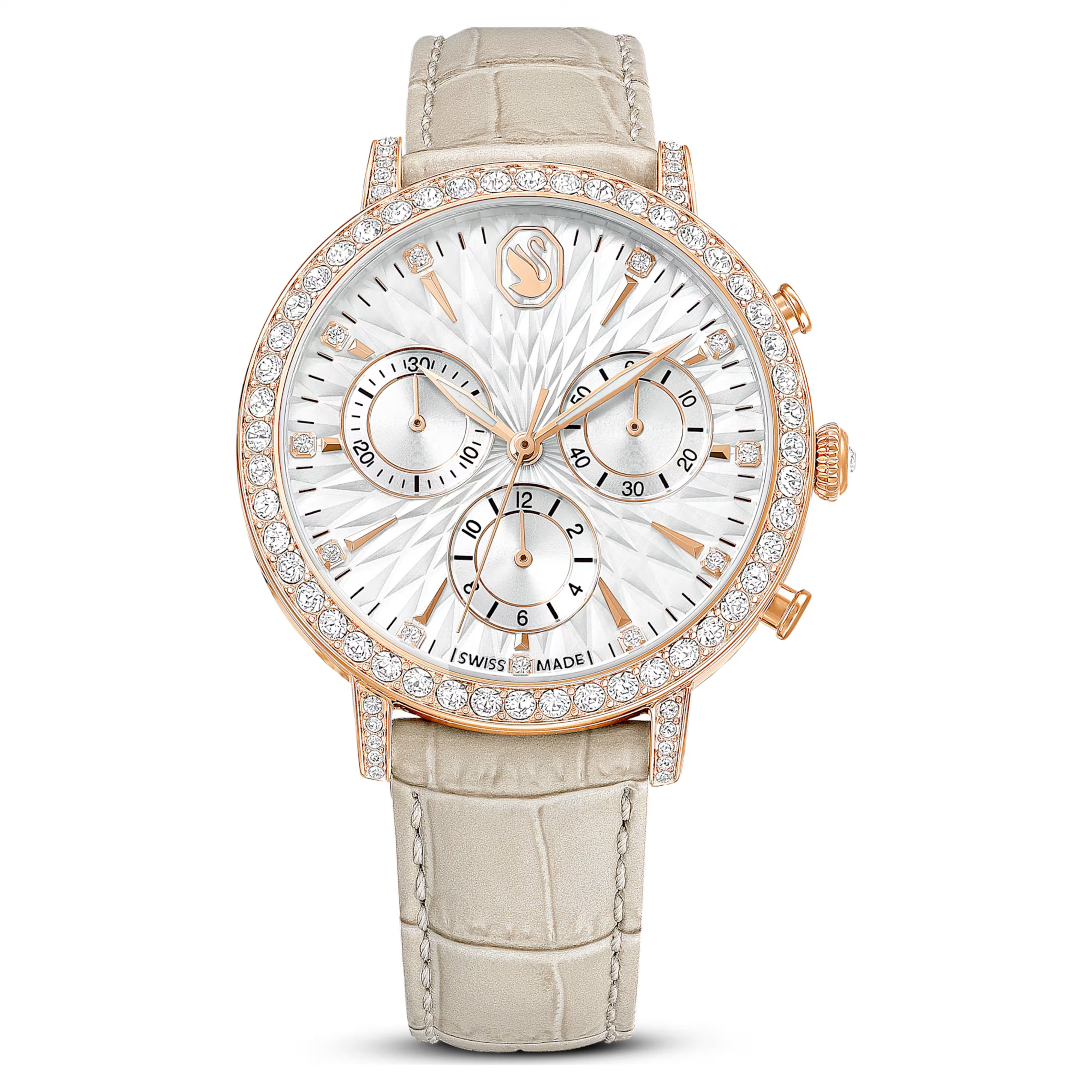
Consumer products: jewellery, watches (Swiss made, since 1999), home décor, chandeliers, glass sculptures, figurines and collectibles, accessories. Subsidi ary businesses include Tyrolit (industrial abrasives), Swareflex (road safety/reflective markings), Swarovski Gemstones (synthetic and natural gemstones), Swarovski Optik (optical instruments), Swarovski Lighting (architectural crystal lighting), and Chamilia (beads, charms, and charm jewellery). Crystal glass is produced lead-free since 2012; Aurora Borealis (AB) coating creates a rainbow surface effect; other proprietary coatings include Crystal Transmission, Volcano, Aurum, Shimmer, and Dorado. The 2004 Xilion cut is a copyrighted precision cut optimising brilliance in flat-back Roses and Chatons.
Swarovski operates approximately 3,000 retail stores globally, supplemented by e-commerce. The B2B crystal elements supply business distributes through wholesale channels to the fashion, costume, and luxury design industries - this commercial pipeline is distinct from the consumer retail operation. Notable B2B partnerships include the Rockefeller Center Christmas Tree star/snowflake (2.7m diameter, 250kg, supplied annually since 2004), Victoria's Secret Heavenly Luxe perfume bottle (2014), Royal Canadian Mint collector coins (2006 onwards), and the Dior exhibition at the Victoria and Albert Museum (2019). The Skims x Swarovski body jewellery collaboration (November 2023) and Marvel figurines expansion (April 2024) demonstrate the brand's continued engagement with contemporary pop-cultural licensing.
Swarovski occupies a unique position as both a luxury consumer brand (jewellery, accessories, home) and a B2B supplier of crystal elements to the global fashion, costume, and luxury design industries. The crystal elements business supplies rhinestones, flatbacks, and set stones to fashion designers, couture houses, costume designers, and apparel manufacturers worldwide. Brand value is sustained through designer collaborations, arts patronage, and cultural product placement (film, fashion shows, theatrical productions). FashionUnited ranked the brand 22nd globally by fashion brand value in 2025.
Swarovski's relevance to surface pattern design operates across several professional contexts:
Swarovski is an Austrian family-founded luxury goods conglomerate headquartered in Wattens, Tyrol, Austria.
Consumer products: jewellery, watches (Swiss made, since 1999), home décor, chandeliers, glass sculptures, figurines and collectibles, accessories.
Swarovski occupies a unique position as both a luxury consumer brand (jewellery, accessories, home) and a B2B supplier of crystal elements to the global fashion, costume, and luxury design industries.
Swarovski operates approximately 3,000 retail stores globally, supplemented by e-commerce. The B2B crystal elements supply business distributes through wholesale channels to the fashion, costume, and luxury design industries - this commercial pipeline is distinct from the consumer retail operation.
The company was co-founded in 1895 as A. Kosmann, D. Swarovski & Co. by Daniel Swarovski, financier Armand Kosmann, and Franz Weis. Tyrolit (grinding and cutting tools) was founded as a subsidiary in 1919.
Austria